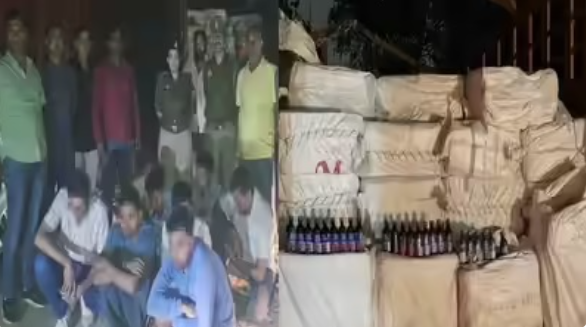
Ghaziabad– In one of the largest crackdowns on the illicit narcotics trade disguised as pharmaceuticals, Ghaziabad Police and the Crime Branch seized over 15.7 lakh bottles of banned codeine-based cough syrup worth approximately ₹3.4 crore from a warehouse on the outskirts of the city. Eight individuals, including a prominent local pharmacist and association treasurer, were arrested in a joint operation triggered by intelligence from Sonbhadra Police, exposing a sophisticated cross-border smuggling network that supplied the addictive substance to multiple states and even Bangladesh.
The raid, executed late Tuesday night at the Bareilly-Gorakhpur Transport warehouse—locally known as ‘Machhli Godown’—near Ghukna Mod along the Delhi-Meerut Road, uncovered 15,73,500 Bottles packed in 1,150 cartons. The contraband, comprising brands like Eskuf, Phensedyl, and Tapentadol, was concealed beneath gunny bags of limestone in four trucks that had been falsely documented as transporting construction materials from Indore, Madhya Pradesh, to Guwahati, Assam. Each carton held around 1,000 bottles, totaling over 15,735 liters of the syrup, which is classified as a narcotic under the Narcotic Drugs and Psychotropic Substances (NDPS) Act due to its high codeine content and rampant misuse as an intoxicant among youth.
Key Arrests and Roles in the Syndicate
The operation led to the apprehension of eight key operatives, who were produced in court and remanded to judicial custody following the registration of an FIR at Nandgram Police Station under relevant NDPS sections. The accused include:
Saurav Tyagi (37): The alleged mastermind and treasurer of the Ghaziabad Chemist and Druggist Association. A licensed pharmacist running RS Pharma medical store in Indirapuram, Tyagi leveraged his professional ties with pharmaceutical wholesalers in Delhi to procure large consignments under the guise of “returned stock” or “repackaged goods.” He coordinated logistics and forged documentation to evade checks.
Santosh Bhadana (32-46): A major transporter and warehouse operator whose facility was used as a storage hub. Bhadana handled the concealment and dispatch of shipments.
Shadab (29) and Shiv Kant alias Shivakant (32): Tyagi’s employees responsible for record-keeping, fake invoicing, and on-ground logistics.
Ambuj Kumar (26): Assisted in hiding the syrup at the warehouse and loading trucks.
Dharmendra Kumar Singh (49), Deepu Yadav (24-26), and Sushil Yadav (35-46): Truck drivers and aides involved in the transport chain.
During interrogation, Tyagi and Bhadana confessed to distributing the syrup across the National Capital Region (NCR), including Delhi, Noida, and Meerut, as well as to eastern states like Uttar Pradesh, Bihar, Jharkhand, and West Bengal. Shockingly, a portion of the haul was earmarked for smuggling into Bangladesh via porous borders, highlighting the syndicate’s international reach.
Modus Operandi: Forgery and Concealment in Plain Sight
The gang’s operations were a textbook case of exploiting regulatory loopholes in the pharmaceutical supply chain. Codeine syrups require strict documentation for transport and storage beyond 1 kg, but the accused bypassed this by fabricating e-way bills, counterfeit invoices, and transport manifests using seven rubber stamps and letterheads from fictitious pharma firms. Shipments were repackaged in industrial zones, labeled as “medical supplies” or innocuous cargo, and hidden under layers of lime sacks, cement, or even rotten rice to dodge routine inspections at checkpoints.
The network traced its origins to a Delhi-based carry-and-forward unit linked to major drug manufacturers, where syrups—originally intended for legitimate cough relief—were diverted into the black market. Production of Phensedyl, for instance, was halted by Abbott Pharma in Baddi, Himachal Pradesh, in December 2024, making any circulating stock highly suspect and illegal. The syndicate’s efficiency was evident in seized items: ₹20 lakh in unaccounted cash (suspected drug proceeds), a Hyundai Creta SUV (UP 14 FB 2244) used for reconnaissance, two laptops with transaction logs, 10 mobile phones and fake SIM cards, 19 strips of Tapentadol extended-release tablets, and a trove of forged documents.
This bust follows a tip-off from Sonbhadra Police, who intercepted a similar truck last month carrying ₹3 crore worth of cough syrup originating from Ghaziabad, leading to three prior arrests. That breakthrough unraveled threads connecting the Uttar Pradesh gang to broader interstate peddlers.Broader Implications and Ongoing Probe
The seizure underscores the escalating crisis of codeine misuse in India, where such syrups fuel addiction, road accidents, and organized crime, claiming thousands of young lives annually. Ghaziabad, a logistics hub near Delhi, has become a notorious transit point for narcotics, with police reporting a surge in pharma-linked smuggling post the 2024 Phensedyl ban.
Additional Commissioner of Police (Crime) Keshav Chaudhary confirmed the involvement of the Drug Control Department, which collected samples for forensic testing to ascertain if the syrups were counterfeit, tax-evaded, or adulterated. “This is just the tip of the iceberg,” Chaudhary stated. “We’re tracing financial trails, freezing suspicious bank accounts, and coordinating with the Narcotics Control Bureau (NCB) for a multi-state sweep.”
Raids continued through the night at Tyagi’s medical store and associates’ residences in Meerut, Noida, and Varanasi, yielding further evidence of money laundering and potential links to Nepal. Authorities suspect the ring operated for over a year, generating crores through hawala channels and small distributors targeting vulnerable youth in urban slums and border areas.
The Ghaziabad Police have urged the public to report suspicious pharma activities via helplines, emphasizing zero tolerance under Chief Minister Yogi Adityanath’s anti-drug drive. As the investigation deepens, this operation not only disrupts a major supply line but also sends a strong message to those weaponizing medicine for profit.