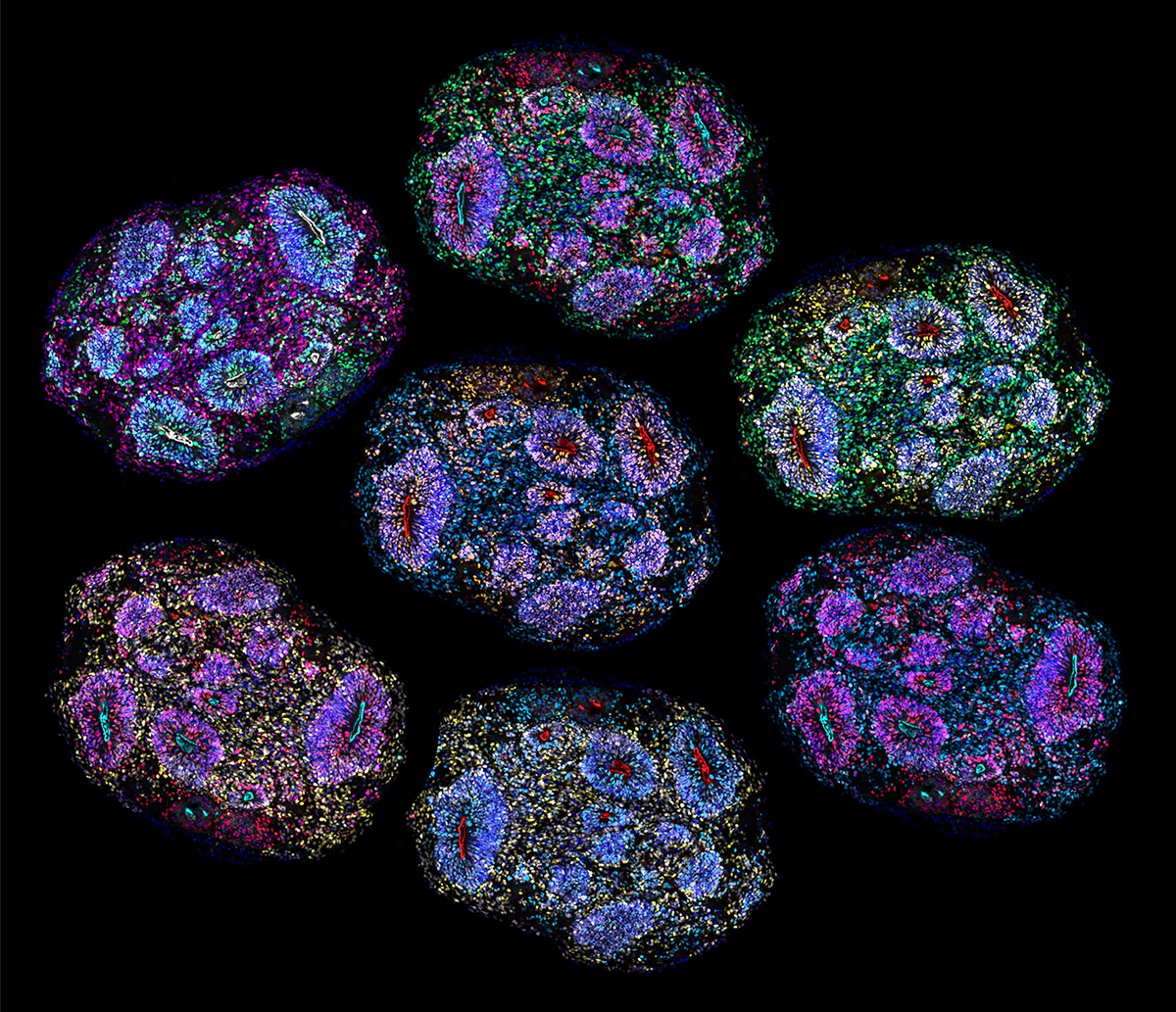
A National Institutes of Health (NIH)-funded scientific team has shown that under the right circumstances, 3D cell culture models of human brain tissue, known as organoids, can express features of later stage brain development. This breakthrough could turn previously unattainable, long-term, benchtop studies of neurodevelopmental disorders into a reality.
“The unprecedented longevity and lifelike qualities of these tissue models could afford us the opportunity to dig deeper into how conditions such as autism emerge and unfold later in life,” said Andrea Beckel-Mitchener, Ph.D., acting director of NIH’s National Institute of Mental Health (NIMH).
While animal models replicate some key features of human brain development, they are not ideal for studying a process that naturally occurs over nearly two decades. Since it is often not feasible to directly examine this process in humans at a cellular level, researchers have sought to build realistic organoids as alternatives.
These models have generally been short-lived, however, only mimicking early development over months in culture. Past attempts have been held back by high batch-to-batch variability as well. A team led by Paola Arlotta, Ph.D., at Harvard University, Cambridge, Massachusetts, previously solved the latter challenge, reporting a method of producing stem-cell derived cerebral cortex organoids of a consistent cellular composition.
In this new study, Arlotta and colleagues tested their organoids’ ability to survive and continue to develop over an extended period. During periods in which organoids survived for nearly six years, the researchers tracked the gene expression, biological age, as indicated by chemical alterations to the genome, and structure of organoid cells and with single-cell resolution.
They detected the emergence and maturation of neurons as well as their supporting glial cells, with many milestones, including signatures of postnatal development, occurring in the same cadence they would naturally in the human brain. Biological age clocks, which are models trained on real-world human data, demonstrated that their molecular and chronological ages matched, signifying that the organoids developed at a slow, realistic pace, despite being grown outside the context of the body.
Neurons also exhibited functional maturity by establishing connections between each other and firing electrical signals that the organoids sustained for at least two years. The authors specifically grew tissue in a fluid that supported this activity, which they suspect was key to their organoids’ neuronal longevity.
“The brain doesn’t develop in a vacuum. It’s an organ of incredible complexity that interacts with so many other systems. It was not a given at all that our simplified model would match natural development in this many ways,” said co-first author Irene Faravelli, M.D., Ph.D., who conducted this work as a post-doctoral research fellow at Harvard.
To be more certain that what they were seeing was not just circumstantial, the authors transferred neurons from older to younger organoids and then gauged their response to the new environment. Despite receiving signals telling them otherwise, the older cells continued progressing as if they were still housed in their prior organoids, skipping developmental steps compared to their younger neighbours.
“I like to think of this as a sort of ‘warping of developmental time’ indicating that the organoid cells record and recall the time they have already spent in culture. This suggests their development is driven by a cell-intrinsic clock, reflecting mechanisms of endogenous human brain development,” said Arlotta.
The findings expand on what scientists previously thought was possible for organoids to accomplish and, moving forward, the authors intend to continue pushing the boundaries. Future research could build on this study by aiming to add anatomical complexity to these organoids, simulating developmental disorders, or testing experimental interventions.
“There is still much to learn about how the embryo naturally builds a progressively more complex and mature brain,” Arlotta said. “Applying these lessons to organoids will allow us to model unexplored events of human brain maturation that occur after birth.”
This research was supported by NIH through NIMH grants RF1MH123977, R01MH112940, RF1MH132710, RF1MH123403, National Institute on Aging (NIA) grants R01AG087374 and R01AG070831, and National Institute of Biomedical Imaging and Bioengineering (NIBIB) grant R01EB024261.
The National Institute of Mental Health (NIMH)’s mission of the NIMH is to transform the understanding and treatment of mental illnesses through basic and clinical research, paving the way for prevention, recovery, and cure.
The National Institutes of Health (NIH), the nation’s medical research agency, includes 27 Institutes and Centers and is a component of the US Department of Health and Human Services. NIH is the primary federal agency conducting and supporting basic, clinical, and translational medical research, and is investigating the causes, treatments, and cures for both common and rare diseases.