Snake Research Institute hands over lyophilised venom of four major venomous snake species found in state to a Telangana-based anti-venom manufacturer
Gujarat is expected to have the first batch of its region specific anti-snake venom in around a year, a development that is expected to significantly strengthen snakebite treatment in the state and contribute to India’s goal of reducing snakebite deaths by 50 per cent by 2030.
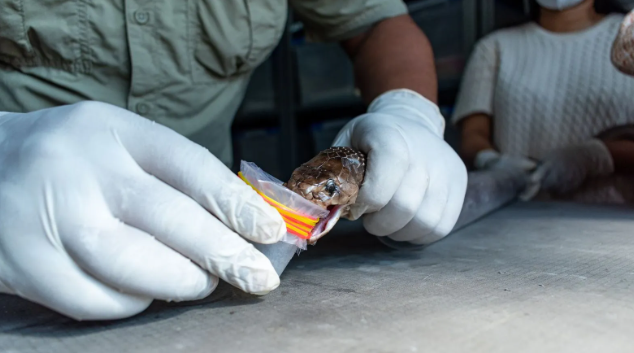
Gujarat government’s Dharampur-based Snake Research Institute (SRI) has recently handed over lyophilised (freeze-dried) venom of four major venomous snake species found in the state to a Telangana-based licensed anti-venom manufacturer and the company is expected to manufacture first region specific anti-snake venom for the state within a year.
The announcement was made by the state government in an official release on Sunday.
The four major venomous snake species found in Gujarat include Indian Cobra, Common Krait, Russell’s Viper and Saw-scaled Viper.
“Last week, the Snake Research Institute, which functions under the Gujarat Forestry Research Foundation (GFRF), handed over the venom purchased through an e-auction to Telangana-based M/s Vins Bioproducts Limited, which is engaged in developing life-saving antisera for snake and scorpion bites, as well as tetanus, diphtheria, and gangrene antitoxins. The consignment comprised 33.37 grams of Indian Cobra venom, 2.67 grams of Common Krait venom, 30.82 grams of Russell’s Viper venom, and 1.71 grams of Saw-scaled Viper venom,” the statement said.
“The milestone comes shortly after the institute received higher-than-expected prices during its first e-auction of lyophilised snake venom, reflecting the high quality of the venom produced under internationally accepted standards,“ it added.
Forest and Environment Minister Arjun Modhwadia said Gujarat is committed to developing its own region-specific anti-venom to reduce snakebite-related deaths.
“The Snake Research Institute (SRI) follows the World Health Organization (WHO) guidelines for snake handling and venom extraction, ensuring the production of high-quality venom for the development of anti-venom,” Modhwadia said, according to the statement.
Why region-specific anti-venom is important
Citing officials of the Forest Department, the release said, “The development of a region-specific anti-venom is of immense public health significance, as snakebites account for the highest number of fatalities arising from human-wildlife conflict in India. More importantly, a large proportion of these deaths are preventable with timely access to effective anti-venom.”
Quoting S K Srivastava, Director, Gujarat Forestry Research Foundation, the release stated, “As per the available official statistics, 550 people died in wildlife attacks across the country in 2022, whereas nearly 65,000 people lost their lives to snakebites during the same period. This stark contrast underscores the urgent need for region-specific anti-venom. Since it is developed using venom from snakes found in a particular geographical region, it is expected to be more effective, requires a lower dosage, and significantly reduces the risk of severe complications such as organ failure, thereby improving patient outcomes and saving lives.”
Explaining the importance of region-specific anti-snake venom, the release said, “Medical experts say the initiative could transform snakebite treatment in Gujarat because snake venom varies geographically, even within the same species. Anti-venom manufactured using venom collected from snakes in other parts of the country may not always provide optimum protection against bites from snakes native to Gujarat.”
Quoting Vice-Chairman of SRI, Dr D. C. Patel, the release stated, “One of the key challenges in treating snakebites is that snake venom varies from one region to another. Anti-snake venom prepared using venom from distant regions often proves less effective. The institute focuses on collecting venom from venomous snake species found across Gujarat so that region-specific anti-venom can be developed.”
“Recognising this scientific challenge, the Gujarat government established the Snake Research Institute in Dharampur, Valsad district, to collect venom from venomous snakes found across Gujarat and support the development of anti-venom specifically suited to the state’s snake population,” the release stated.