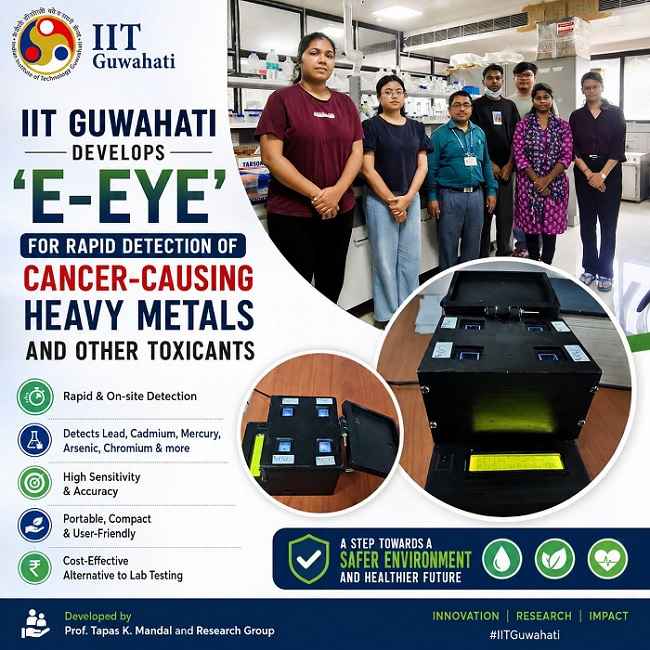
GUWAHATI: Indian Institute of Technology Guwahati researchers have developed an optical sensing device that can instantly detect a variety of toxicants in water and other biological samples.
Aligned with the Government of India’s Jal Jeevan Mission, this innovation addresses a key challenge of ensuring safe drinking water. While the mission aims to provide tap water to every household, maintaining water quality remains a challenge due to different water sources, which may contain heavy metals and other disease-causing bacteria.
To address this challenge of water quality monitoring, the research team has developed a portable point-of-care testing device named E-Eye. Working as an electronic eye, it detects multiple toxicants on-site while maintaining high accuracy, and transmits the recorded data wirelessly to water treatment facilities.
The findings of this research have been published in the prestigious IEEE Sensors Journal, in a paper co-authored by Prof. Tapas K. Mandal and Prof. Harshal B. Nemade, along with research scholars, Mr. Shrikant Kashyap, Ms. Smriti Sachan, and Ms. Neha Majee from IIT Guwahati, Ms. Maitrayee Bhuyan from KIIT Bhubaneswar, and Mr. Humayun Kabir from Ramakrishna Mission Residential College, Kolkata.
E-eye works through a chemical reaction that produces a colored compound, in which color intensity highlights the concentration of the toxicants. Using basic optical principles, the device analyses the water, converts the sensor’s output into digital data and displays the toxicant concentration.
Contrary to conventional, costly laboratory instruments, E-Eye is suitable for direct field deployment, where it can detect water toxicants right at the water source. During laboratory tests, the research team found that results shown by E-Eye are comparable to those of standard UV-Visible and Atomic Absorption spectrophotometers (AAS), while offering advanced digital integration functionality.
Speaking about the developed innovation, Prof. Tapas K. Mandal, Professor, Department of Chemical Engineering, IIT Guwahati, said, “The device operates on the Beer-Lambert law and combines optical sensing with digital electronics to generate accurate quantitative measurements. Our device has successfully detected toxicants such as arsenic, lead, iron, chromium, fluoride, and Escherichia coli bacteria.”
The E-Eye device has been developed at a cost of approximately Rs. 3,500, with a per-sample testing cost of around Rs. 2. The cost of the device can be reduced further through large-scale industrial production.
Other than water quality monitoring, the device is capable of analysing toxicants in environmental samples, biological samples, vegetables, food products, tea and herbal products, soil, and milk as well. The research team has tested more than 2700 samples with the developed device and recorded accurate results.
Speaking about the impact of the developed innovation, Prof. Harshal B. Nemade, Professor, Department of Electronics and Electrical Engineering, IIT Guwahati, said, “E-Eye has prominent application potential across government departments, industries, and private enterprises. It can support agencies under the Ministry of Jal Shakti in water quality monitoring, assist food and herbal product manufacturers, and help industries monitor liquid effluents containing heavy metals, bacteria, and odor-causing compounds.”
Supported by a research grant from the Ministry of Electronics and Information Technology (MeitY), the research team has established a startup, ENVIONIX Labs Pvt. Ltd., to commercialise the developed technology. Additionally, the team also plans to collaborate with an industry partner to initiate technology transfer and bring this innovation from lab to land.
As the next step, the team is working on integrating solar panels into the developed technology to make it self-sustaining and enable cloud connectivity for remote monitoring and data management.
This unique innovation from IIT Guwahati highlights a major milestone toward affordable, indigenous, and smart sensing technologies that can strengthen environmental monitoring, public health, industrial compliance, and sustainable resource management in India.