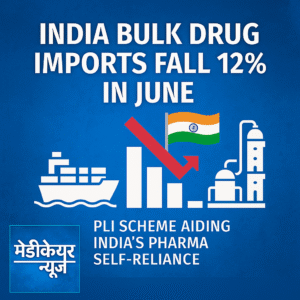
New Delhi, August 5, 2025 — India’s pharmaceutical sector is showing strong signs of self-reliance, as imports of bulk drugs and drug intermediates declined for the third consecutive month in June.
According to the Ministry of Commerce and Industry, imports fell 12.4% year-on-year to $327.1 million, down from $373.2 million in June 2024. However, the quantity of imports slightly increased from 38,126 metric tonnes to 38,889 MT, suggesting that cost efficiency—rather than volume cuts—is driving the trend.
Consistent Downtrend in Import Value
June’s decline follows similar contractions in April (2.3%) and May (6.3%). In rupee terms, the value of bulk drug imports in June stood at ₹2,809.5 crore, a 9.8% drop compared to ₹3,115 crore in the same month last year.
In the first quarter of FY26 (April–June), the total import value was $1.08 billion, marking a 6.9% decline from the same period last year. Meanwhile, import volume rose 1.44% to 1,26,817 MT, reflecting a reduced per-unit cost of acquisition.
🇮🇳 Domestic API Industry Gains Traction
This fall in import dependence closely follows the Indian government’s push to strengthen local manufacturing under the Production-Linked Incentive (PLI) Scheme for APIs and key intermediates. As of March 2025, investments under PLI totaled ₹4,570 crore, exceeding the original commitment of ₹3,938 crore.
Notably, sales from PLI-supported production have hit ₹22,658 crore, including ₹1,817 crore from PLI-enabled output. Of this, ₹455 crore was exported, and ₹1,362 crore worth of imports were replaced, covering 25 priority Active Pharmaceutical Ingredients (APIs), intermediates, and key starting materials (KSMs).
📌 Read how India is expanding PLI-enabled pharma parks →
Over 190 APIs Now Made in India
The initiative has enabled India to domestically manufacture over 190 APIs and intermediates for the first time. Government-backed bulk drug parks, like those in Gujarat, Himachal Pradesh, and Andhra Pradesh, are also expanding local production capabilities.
The Central Drugs Standard Control Organisation (CDSCO) and the Department of Pharmaceuticals (DoP) continue to provide regulatory and financial support to manufacturers entering this critical sector. Visit CDSCO →
Global & National Significance
India’s pharma sector has long been dubbed the “pharmacy of the world.” However, it remained dependent on Chinese imports for over 60–70% of APIs. The current trend of reduced imports and rising domestic output marks a critical milestone in India’s Atmanirbhar Bharat (self-reliant India) vision.
This transition not only reduces India’s exposure to global supply chain shocks but also strengthens its standing as a reliable export hub for essential generics and drug components.
 Conclusion
The drop in API import value, despite steady volume, signals a transformative shift in India’s pharma manufacturing strategy. As PLI investments continue to bear fruit, the country could become a global leader in API manufacturing, offering quality, affordability, and supply chain resilience.