Hyderabad – A groundbreaking study by the Indian Council of Medical Research’s National Institute of Nutrition (ICMR-NIN) has established a clear association between micronutrient deficiencies and elevated dementia risk among Indian adults, underscoring nutrition’s critical – and modifiable – role in brain health and healthy ageing.
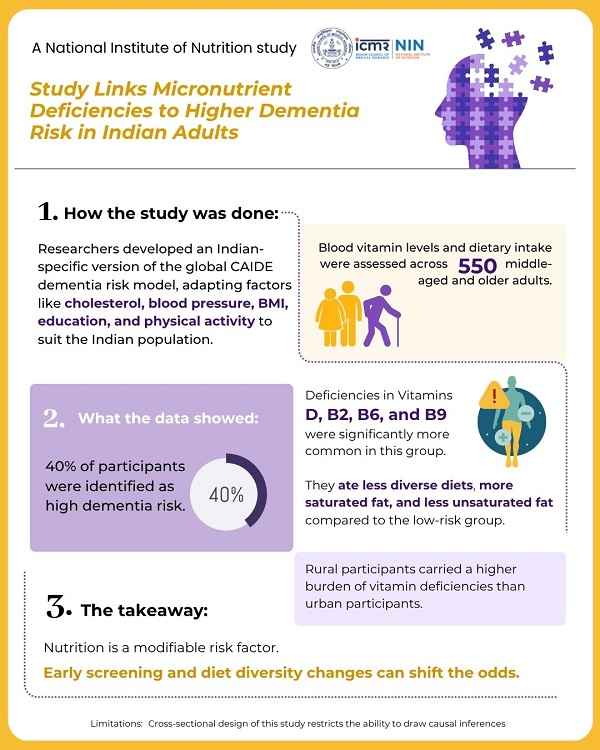
The community-based cross-sectional research, published in The Lancet Regional Health – Southeast Asia, examined 570 middle-aged and older adults aged 40 to 80 years drawn from both rural and urban areas of Telangana. Researchers assessed dementia risk using a culturally adapted version of the Cardiovascular Risk Factors, Ageing and Incidence of Dementia (CAIDE) score, evaluated cognitive performance with the Montreal Cognitive Assessment (MoCA) tool, measured blood concentrations of key vitamins through advanced laboratory techniques, and analysed participants’ dietary intake and diversity.
Nearly 40 per cent of the participants were classified as having a higher predicted risk of dementia. Those in the higher-risk group consistently showed poorer nutritional status, including significantly higher prevalence of deficiencies in vitamins D, B2 (riboflavin), B6 and B12. They also reported lower dietary diversity, consumed more saturated fats and fewer unsaturated fats compared with the lower-risk group. Deficiencies were notably more common among rural participants than their urban counterparts.
Lead investigator Dr G Bhanuprakash Reddy, Scientist G at ICMR-NIN, said the findings highlight a pressing public-health concern as India’s older population expands. “As India’s ageing population continues to expand, the number of people living with dementia is expected to rise substantially by 2050. Our findings highlight that micronutrient status is closely linked with the burden of dementia risk factors among Indian adults,” he noted. “Although the cross-sectional design of this study restricts the ability to draw causal inferences, the study emphasises that nutrition, particularly micronutrient adequacy and dietary diversity, represent a modifiable factor that can be targeted through public health interventions.”
ICMR-NIN Director Dr Bharati Kulkarni echoed the urgency. “Given that effective disease-modifying therapies for dementia remain limited, prevention through early identification of risk factors and timely intervention becomes increasingly important. This study provides important evidence that nutritional factors, especially micronutrient status, should be integrated into dementia prevention strategies in future,” she stated.
The research, conducted in collaboration with the Stanford Center for Innovation in Global Health in the United States and Sweden’s Karolinska Institute, adds to a growing body of evidence on modifiable dementia risks. Low- and middle-income countries such as India already shoulder nearly 60 per cent of the global dementia burden, with roughly half of all cases linked to factors such as hypertension, diabetes, obesity, physical inactivity, smoking, depression and social isolation. Nutrition, the study suggests, could be a powerful additional lever.
Importantly, the findings point to practical dietary solutions. Participants with diets rich in micronutrients – particularly those high in fruits and vegetables – exhibited a lower burden of dementia risk factors. The researchers advocate for public-health measures to improve micronutrient adequacy and dietary diversity across the life course, especially in rural communities where deficiencies appear more pronounced.
While the study stops short of proving causation, its authors stress that the strong observed associations warrant urgent attention. With no cure currently available for most forms of dementia and India’s elderly population projected to surge in the coming decades, experts say bolstering nutritional status through fortified foods, dietary counselling and awareness campaigns could emerge as a cost-effective strategy to safeguard cognitive health nationwide.
The ICMR-NIN has called on policymakers to incorporate these insights into national programmes on non-communicable diseases and healthy ageing, urging citizens to prioritise nutrient-dense diets as a proactive step against cognitive decline.