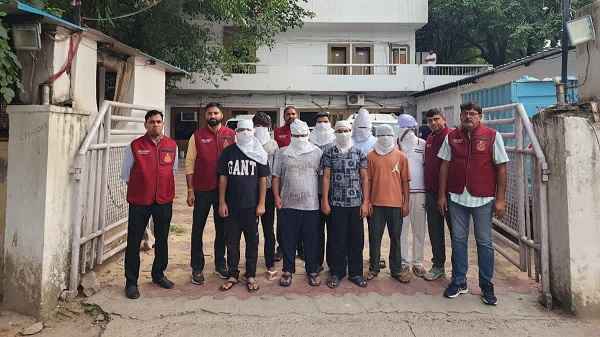
New Delhi: The Delhi Police Crime Branch has busted a major interstate syndicate allegedly involved in the illegal procurement, diversion, storage, repackaging and sale of counterfeit and illegally obtained high-value anti-cancer medicines, arresting 17 persons and seizing medicines and other material estimated to be worth around ₹9 crore.
According to the Delhi Police Crime Branch, the operation exposed a network allegedly spread across Delhi-NCR, Maharashtra, Telangana, Haryana, Uttar Pradesh and Rajasthan, involving medicine traders, intermediaries and persons associated with hospital Police said the syndicate obtained costly oncology medicines through counterfeit sources as well as by allegedly diverting genuine medicines intended for cancer patients and government institutions.
The case has assumed particular significance because the alleged racket involved not merely counterfeit medicines but also the suspected diversion of genuine anti-cancer drugs from hospitals and government supply channels, potentially depriving cancer patients of life-saving treatment.
588 filled anti-cancer vials and ₹50 lakh cash seized
The Crime Branch has reported a substantial seizure during the investigation.
The seizure includes:
588 filled anti-cancer medicine vials
6 empty vials
7 empty medicine boxes
3,021 units of other medicines
Approximately ₹50 lakh in cash
Electronic devices
Registers and diaries containing transaction and financial details
Packaging and repackaging material.
The total value of the medicines and other seized material has been estimated at approximately ₹9 crore.
The recovered oncology medicines reportedly include Darzalex, Imfinzi, Erbitux, Opdyta, Gazyva, Bavencio, Adcetris and Keytruda—high-value medicines used in cancer treatment.
The recovery of empty vials, empty cartons and packaging material has become an important part of the investigation, with police examining whether the network was engaged in repackaging or manipulating the presentation of medicines before their illegal sale.
Major individual recoveries
Among the largest seizures was the recovery from Anand Kumar, from whose possession and premises police recovered 337 anti-cancer vials, besides a substantial quantity of other medicines.
From the residence of Deepak alias Ravi, investigators recovered another 108 anti-cancer vials and ₹6.50 lakh in cash.
These recoveries are expected to help investigators establish the source, movement and intended destination of the medicines by matching batch numbers and other identifying details with manufacturers, distributors, hospitals and government procurement records.
How the alleged network obtained cancer medicines
The Crime Branch investigation has identified three principal channels through which the syndicate allegedly procured expensive anti-cancer medicines.
The first involved procurement of counterfeit medicines from unauthorised sources.
The second allegedly involved the diversion or misappropriation of genuine medicines stored in hospitals for cancer patients.
The third allegedly involved the illegal diversion of medicines supplied to government institutions and warehouses before they reached the intended beneficiaries.
Police further alleged that the medicines were being procured and traded without valid invoices, purchase records, drug licences or other mandatory documentation.
Investigators have also reportedly recovered registers and diaries containing details of cash transactions and drug deliveries. The alleged use of old cartons and packaging material, including the removal of identifying markings, is being examined as part of the investigation.
17 accused arrested across multiple States
The Delhi Police Crime Branch has arrested the following 17 persons, according to the police-linked reports:
Delhi
Abhishek Vaishya, 26 — Laxmi Nagar
Shubham Kumar Chaudhary, 25 — Laxmi Nagar
Suraj Chaudhary, 22 — Laxmi Nagar
Satish Kumar, 30 — Govindpuri
Uttar Pradesh
Gagan, 28 — Indirapuram, Ghaziabad
Vishwas Tyagi, 35 — Ghaziabad
Anand Kumar, 42 — Noida
Haryana
Mukesh, 30 — Gurugram
Mayank Garg, 35 — Gurugram
Deepak alias Ravi, 33 — Faridabad
Jaswant Sharma, 42 — Faridabad
Paramjeet Sheoran, 34 — Jhajjar
Telangana
Srinivasulu Kalva, 52 — Hyderabad
Ramdas Satish Kumar, 42 — Hyderabad
Malugari Srinath Reddy, 35 — Hyderabad
Maharashtra
Ayush Kumar, 23 — Navi Mumbai
Rajasthan
Manish Sharma, 28 — Alwar
The arrested persons allegedly occupied different positions within the supply chain, including medicine trading, intermediary operations and hospital-linked activities.
Alwar hospital diversion allegation
The Rajasthan connection is particularly significant. Police have alleged that one of the accused in Alwar was involved in diverting anti-cancer injections that had been stored at a hospital for patients.
This allegation is now being examined alongside the separate recovery of government-stock oncology medicines reportedly linked to PBM Hospital, Bikaner.
The Bikaner episode has prompted an examination of records by the Rajasthan Medical Services Corporation Limited (RMSCL). PBM Hospital, however, has denied any deliberate diversion and said that medicines received from RMSCL were properly recorded and accounted for.
A Dainik Bhaskar report has separately stated that an RMSCL inspection team visited the concerned drug warehouse and obtained records, with 294 vials shown as consumed so far. The consumption figure by itself does not establish diversion; investigators will have to reconcile procurement, receipt, issue, patient-wise administration and remaining stock.
Investigation began on June 22
The Crime Branch said it received specific intelligence on June 22, 2026 regarding an organised syndicate allegedly engaged in the large-scale procurement, storage and supply of counterfeit and high-value anti-cancer medicines.
During verification, investigators identified suspected locations in East Delhi, Rohini and Mumbai.
On July 11, seven teams of the Inter-State Cell conducted simultaneous raids at several locations in Delhi and Navi Mumbai, in coordination with the Drugs Department and local police.
Following the investigation, an FIR was registered at the Crime Branch police station on July 12, 2026, under relevant provisions of the Bharatiya Nyaya Sanhita, 2023.
Network allegedly operated without licences or purchase records
According to the investigation, the medicines were allegedly stored in residential premises and other locations before being passed through intermediaries.
Police have alleged that transactions took place without proper invoices, purchase records or drug licences. Registers and diaries recovered during the searches are being examined to reconstruct the financial trail and identify other suppliers and purchasers.
The investigation is also examining electronic devices seized from the accused.
The alleged use of chemicals to remove old batch numbers, MRP details and other identifying marks from packaging is particularly significant because such manipulation could make it more difficult to trace the actual origin and legitimate supply chain of the medicine.
Genuine diversion adds a new dimension to counterfeit drug investigations
The case highlights an important distinction in pharmaceutical enforcement.
Counterfeit medicines are illegally manufactured or falsified products. Diverted medicines, however, may originally be genuine products that have been removed from an authorised supply chain and sold through unauthorised channels.
The Delhi investigation appears to encompass both forms of illegal trade.
The alleged diversion of genuine medicines from hospitals and government warehouses raises questions about institutional inventory controls, patient-level dispensing records, warehouse security and the traceability of high-value oncology medicines.
If genuine government-stock medicines were diverted, the financial loss would extend beyond the market value of the product because the medicines were intended to be provided to patients under public healthcare programmes.
₹9 crore seizure exposes vulnerability in oncology supply chain
The recovery of 588 filled anti-cancer vials, together with thousands of other medicines, cash, financial records and packaging material, provides investigators with substantial physical and documentary evidence.
The next stage of the investigation will be to establish:
where each medicine originated; how it left the authorised supply chain; who transported and stored it; who financed the transactions; and where the products were ultimately intended to be sold.
The Crime Branch is also examining the network’s backward and forward linkages and the possibility of further arrests.
Regulatory and patient-safety implications
The case raises concerns that go beyond conventional counterfeit-drug enforcement.
Cancer medicines are expensive, specialised products, many of which are administered under strict medical supervision. Any compromise in their authenticity, storage, handling or traceability can have serious consequences for patients.
The alleged substitution or diversion of genuine medicines can also remain difficult to detect if inventory reconciliation is inadequate.
For government oncology programmes, therefore, an effective audit trail should enable authorities to track each high-value vial from procurement and warehouse receipt through hospital dispensing and patient administration.
The Bikaner inquiry and the Delhi Crime Branch investigation will be important in determining whether existing systems are capable of identifying unexplained losses before medicines reach the black market.
Probe continues
The Delhi Police investigation remains underway. Investigators are examining the seized medicines, electronic devices, registers, diaries and financial records while tracing the wider interstate network.
The arrest of 17 persons and the seizure of medicines estimated at ₹9 crore represent a significant enforcement action, but the investigation will ultimately have to establish the precise role of each accused, the origin of the medicines and the extent of the alleged diversion from hospitals and government institutions.
All allegations against the arrested persons remain subject to investigation and judicial proceedings, and arrest does not by itself establish guilt.
The case nevertheless exposes a serious vulnerability in India’s oncology medicine supply chain: the threat is not limited to counterfeit manufacturing; genuine, life-saving medicines can also become part of the black market if they are diverted after entering legitimate hospital or government supply channels.
Source : Delhi Police