
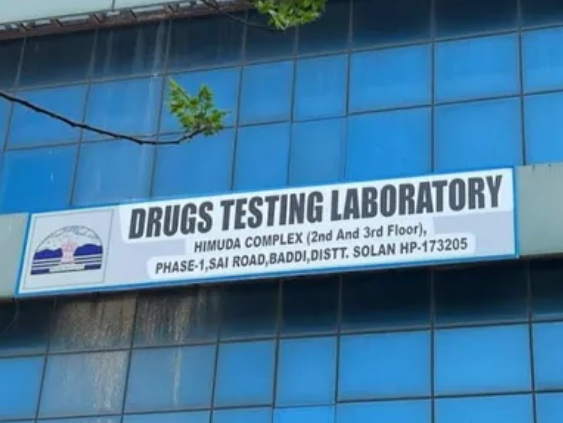
Solan: Inordinate delays in testing drug samples at the Baddi-based Drug Testing Laboratory (DTL) have brought the functioning of the high-profile facility under sharp scrutiny. Set up with an investment of ?30 crore from Central funds, the laboratory was envisioned as a backbone of the state’s drug regulatory system. Instead, repeated lapses in timelines have triggered questions about efficiency, oversight and value for public money.
Even in emergency cases, the laboratory has failed to deliver reports within a reasonable timeframe.
A recent and troubling illustration is the death of a woman in Barotiwala on December 30, 2025, allegedly after consuming a cough syrup. Samples of the drug were drawn by the concerned drug official the same day and dispatched to the Baddi lab that very evening. Despite the urgency, the laboratory took four days to analyse the sample, furnishing its report only on January 2. This delay is stark, given that such testing typically requires just three to four hours on modern analytical equipment.
The laboratory is equipped with 16 high-performance liquid chromatography (HPLC) machines and one gas chromatography machine, along with a staff strength of 67 technical personnel, besides additional support staff engaged in report preparation.
On paper, the infrastructure suggests the capacity for rapid, round-the-clock testing. Yet, ground realities tell a different story.The operation of the lab has been outsourced to a Panchkula-based agency that already runs a similar facility.
Under the agreement, the lab is expected to test between 5,000 and 6,000 drug samples annually, for which the state pays around Rs 5 crore every year. Despite this, the laboratory tests only about 500 samples a month, less than 17 samples a day. Industry sources point out that this translates to each machine being run barely once a day, an underutilisation that borders on the inexplicable.Ironically, the volume of samples reaching the lab is itself modest.
The state has 39 drug inspectors, of whom only around 12 are assigned to manufacturing units. As per the mandate of the Central Drugs Standard Control Organisation (CDSCO), each inspector must draw 10 samples every month. This results in roughly 120 samples being sent to the lab monthly—well within its stated capacity.
Yet, even this limited workload is not being cleared on time. Documents accessed by The Tribune reveal that the lab has repeatedly defaulted on the stipulated 60-day timeline for testing, as prescribed under Rule 45 of the Drugs and Cosmetics Act.
In several instances, samples received as early as April 2025 were tested only in December 2025, while others were analysed as late as January 2026. Such delays effectively defeat the very purpose of having a dedicated government laboratory.
Private laboratories, operating with fewer resources, reportedly test over 20,000 samples annually, charging between Rs 1,200 and Rs 5,000 per sample. In contrast, the Baddi lab charges Rs 10,000 per sample despite its sluggish output.
State Drugs Controller Manish Kapoor confirmed that the lab is mandated to issue reports within 60 days, with extensions permitted only in exceptional circumstances. When questioned about the delays, he said the matter would be examined. Given the tardy pace of testing and the absence of effective oversight, there is an urgent need to review the laboratory’s functioning.
Although the Health Secretary had earlier directed the appointment of an authorised officer to ensure transparency and efficiency, no such officer has been appointed so far—leaving a critical public health institution adrift.



%20In%20Drug%20Development)