

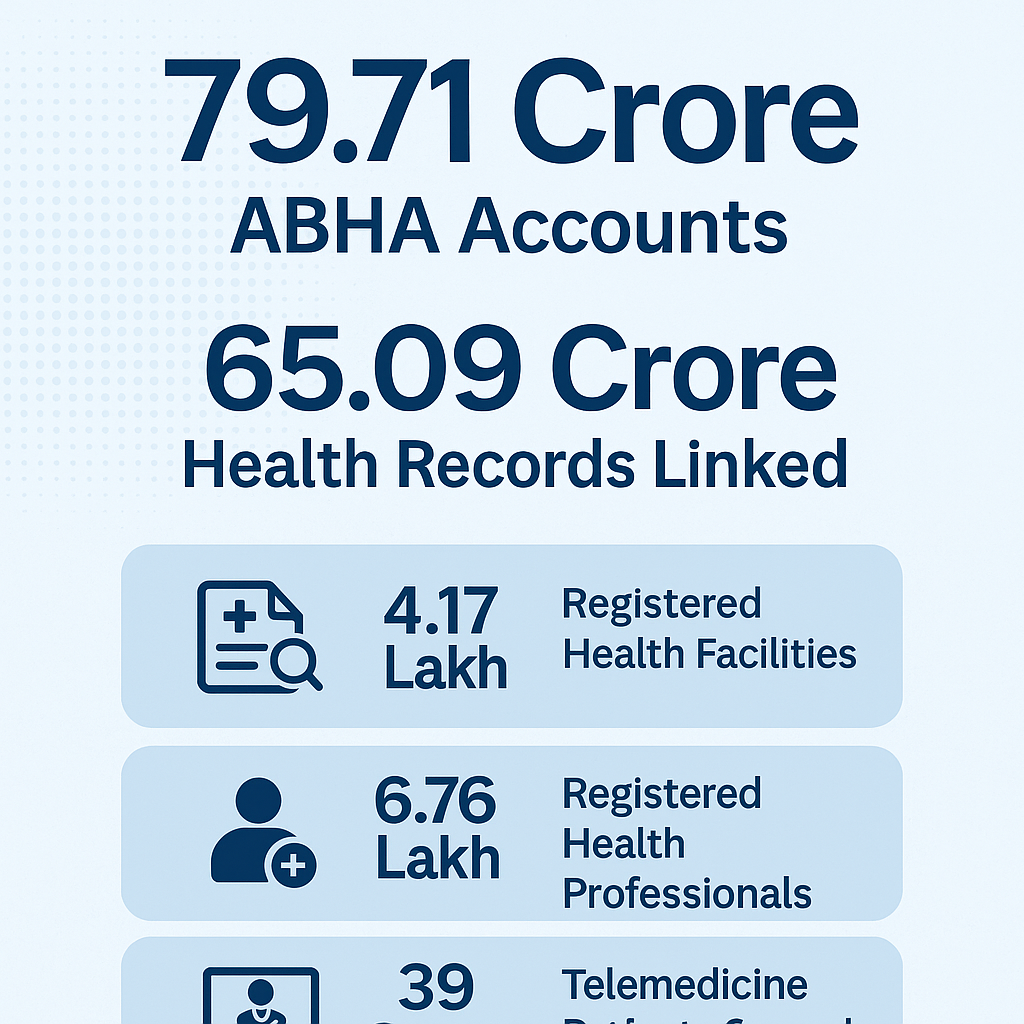
India has reached a big step in digital healthcare. By July 28, 2025, the government created 79.71 crore Ayushman Bharat Health Accounts (ABHA). Out of these, 65.09 crore health records connect directly to the IDs. Health Minister Prataprao Jadhav announced the figures in the Lok Sabha.
The Ayushman Bharat Digital Mission (ABDM) drives this initiative under the National Health Authority (NHA). Its aim is simple — give each citizen a unique health ID. This ID stores medical records securely and allows quick sharing with doctors. As a result, patients get faster care with fewer repeated tests.
So far, 4.17 lakh health facilities appear in the Health Facility Registry. The Health Provider Registry now lists 6.76 lakh healthcare professionals. In addition, 3.20 lakh facilities actively use ABDM-enabled software. These cover 771 districts across India, linking both public and private health services.
To reach remote areas, the government offers offline and assisted registration. This step ensures that citizens without internet access can still join the system. Moreover, a public dashboard now tracks progress in real time, giving updates at state, district, and hospital levels.
The telemedicine platform eSanjeevani works closely with ABDM. It has already served over 39 crore patients in 36 states and union territories. 1,34,029 Ayushman Arogya Mandirs act as local health centres. They connect with 17,568 telemedicine hubs and 719 online OPDs, supported by 2.24 lakh doctors and healthcare workers.
With an ABHA ID, patients manage their health history in one secure place. Doctors can access records instantly when authorised. This saves time, cuts costs, and ensures smooth treatment continuity.
Adoption is growing quickly. More health facilities and professionals join each month. As integration expands, both rural and urban communities will see the benefits. The mission is building a health system that is faster, more transparent, and easier for every Indian to use.






%20In%20Drug%20Development)