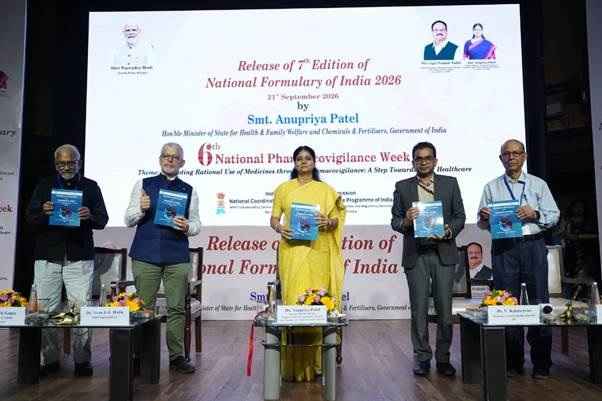
New Delhi / Mumbai: The seventh edition of the National Formulary of India (NFI 2026), an authoritative reference manual for prescribing, dispensing and administering medicines, includes multiple drugs or their variants that have not been approved by the Central Drugs Standard Control Organisation (CDSCO), according to a report by The Economic Times. The Drug Controller General of India (DCGI), who heads the CDSCO, has flagged the issue in a formal communication to the Indian Pharmacopoeia Commission (IPC) and sought the rationale for their inclusion.
The 7th Edition of the NFI was released on September 21, 2026, by Union Minister of State for Health and Family Welfare and Chemicals & Fertilizers Smt. Anupriya Patel during the 6th National Pharmacovigilance Week organised by the IPC at Dr. Ambedkar International Centre in New Delhi. The IPC, an autonomous body under the Union Ministry of Health and Family Welfare, publishes the NFI periodically to promote the rational use of medicines. Official IPC communications state that NFI 2026 contains 653 drug monographs (including 83 new ones), 42 fixed-dose combinations and 30 immunologicals, aligned with the National List of Essential Medicines and national health programmes. It is available in both print and digital formats.
Despite this positioning as a key guidance document within India’s regulatory ecosystem, several entries lack CDSCO marketing approval. The Economic Times reported that it identified at least five such drugs or variants: methylene blue 10 mg/ml injection; flumazenil injection 0.1 mg/ml; folinic acid injection 3 mg/ml and 15 mg tablet; pyridostigmine 30 mg, 60 mg and 180 mg tablets; and alteplase 20 mg and 50 mg injection vials. Sources indicated that additional unapproved drugs are also listed.
According to a senior government official cited by the newspaper, the DCGI sent a note to the IPC in August highlighting the discrepancy. The note emphasised that the IPC, the NFI and related activities form an integral part of the country’s regulatory framework and that “the discrepancy may have international implications and therefore requires an urgent response.” The CDSCO had representation on the NFI core committee and had raised concerns during the preparation of the document, yet the unapproved drugs were still included. A person aware of the matter told the Economic Times that the issue was flagged based on the CDSCO’s position in the committee, with the formal note serving as a final check as launch preparations advanced.
When contacted by the Economic Times, an official from the Indian Pharmacopoeia Commission stated that the best possible efforts were made not to include drugs not approved by the CDSCO in NFI 2026. The newspaper’s request for comment from the DCGI went unanswered.
Separately, the DCGI has described as a “serious concern” complaints from stakeholders about the non-availability of the online version of NFI 2026. A letter sent after the publication of the reference manual noted these accessibility issues.
The National Formulary of India is intended as an evidence-based guide linking scientific standards with clinical practice for doctors, pharmacists, students and other healthcare professionals. The inclusion of drugs lacking central regulatory approval has raised questions about consistency between the formulary and the CDSCO’s approval processes under the Drugs and Cosmetics Act, 1940, and the New Drugs and Clinical Trials Rules, 2019.
This development occurs against a broader backdrop of ongoing regulatory efforts to address unapproved drugs and fixed-dose combinations in India, including recent discussions by the Drugs Consultative Committee on strengthening definitions of “approved” drugs and compiling comprehensive databases.
Disclaimer: This news report is drafted on the basis of the cited Economic Times article, official statements and materials available from the Indian Pharmacopoeia Commission, and related public sources. It presents information as reported and does not constitute independent verification of the approval status of individual drugs. Readers are advised to consult official CDSCO and IPC publications, regulatory filings, or qualified professionals for the latest and authoritative information on drug approvals and formulary contents. The article is intended for informational purposes only.
Source : Economic Times