New Delhi: Painkillers, anti-infectives and medications for type-2 diabetes were among the class of drugs flagged as not of standard quality (NSQ) and spurious the most in 2024, according to data collated from drug alerts issued by the Central Drug Standards Control Organisation (CDSCO).
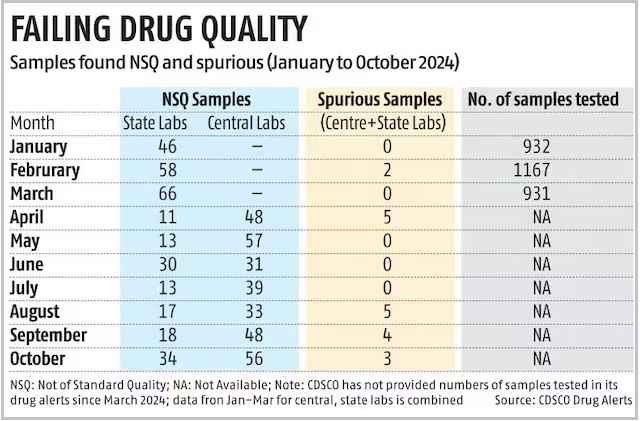
The apex drug body and state drug authorities have flagged 618 drugs and formulations as NSQ, whereas 19 were found spurious between January and October, according to the data.
Among the commonly used analgesic formulations (painkillers) found NSQ are combinations of paracetamol with ibuprofen, diclofenac and mefenamic acid. Medications using these combinations are commonly used to treat fever, mild migraine, period and muscle pain.
According to market research firm Pharmarack, analgesics form the seventh biggest therapy group in terms of revenue contribution to the Indian pharma market (IPM) in October 2024, with its moving annual turnover (MAT) at Rs 15,179 crore.
Other common varieties of drugs labelled as NSQ are anti-infectives, which include antibiotics, antibacterial and antifungal medications. Anti-infectives are the third biggest contributor to the IPM revenues, with its MAT reaching Rs 25,682 crore in October.
While the apex drug regulator does not mention the brand names, it has flagged several formulations and drug combinations in its drug alerts.
The central body has also not provided the total number of samples tested by it since March 2024, leaving only the absolute numbers of drugs found not of standard quality.
Formulations that have frequently failed quality tests this year include fixed dose combinations (FDC), including cefixime, azithromycin and lactobacillus.
FDC’s are drugs that contain a combination of two or more active pharmaceutical ingredients (APIs) in a single form, usually manufactured and distributed in a fixed ratio.
Similarly, drugs for type-2 diabetes and hypertension such as glimepiride tablets and diuretics such as spironolactone tablets have also been frequently flagged as NSQ this year. This therapy area forms the fourth largest therapy group in terms of revenue in IPM.
According to the World Health Organization (WHO), there are estimated 77 million people above the age of 18 years suffering from diabetes (type-2) in India, along with nearly 25 million pre-diabetics who are at a higher risk of developing the disease in near future.
Meanwhile, batches of popular gastrointestinal (GI) drugs like Pan D, which is marketed by Alkem Laboratories have been found to be spurious most often, with the drug being flagged for three successive months, according to the data.
While the CDSCO alerts have named 19 brands this year for which they found spurious samples, the alerts do not name the drugmakers. These include popular brands such as antibiotics Taxim-O 200 (Alkem), Rosuvas 10 (Sun Pharma), calcium supplement Shelcal 500 (Torrent Pharma) and Telma H (Glenmark Pharma).
According to the Drugs and Cosmetics Act, a drug shall be deemed to be spurious if it is manufactured under a name which belongs to another drug, is an imitation of another drug, has been substituted wholly or partly by another drug or if it wrongly claims to be the product of another manufacturer.
The companies, meanwhile, have denied their drugs failing the tests, calling the tested batches spurious versions and not manufactured by them.
“The actual manufacturer (as per label claim) has informed that the impugned batch of the product has not been manufactured by them and that it is a spurious drug. The product is purported to be spurious, however, the same is subject to the outcome of investigation,” the drug standards body has stated in its alerts.