The FSDA has sent proposals to the state and central govts after teams scrutinised purchase and sale records of medicine wholesale traders during inspections in Ranchi, Delhi, and Lucknow and found glaring lapses.
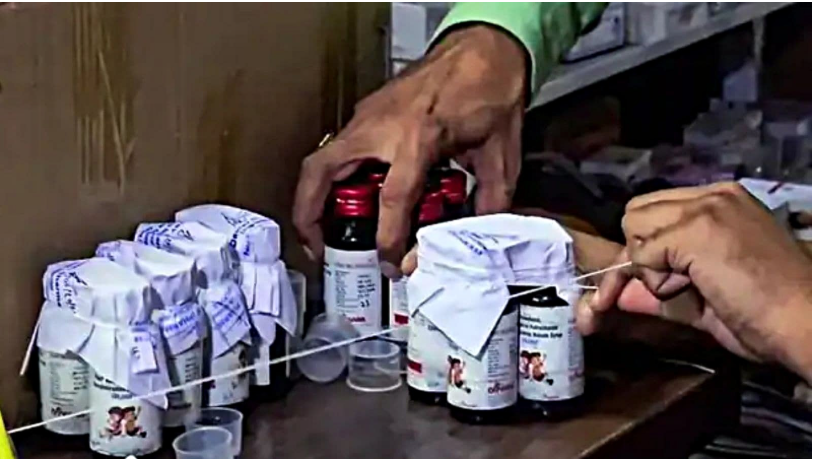
After authorities unearthed a Rs 700-crore cartel dealing in codeine-based cough syrup (CBCS), the Uttar Pradesh Food Safety and Drug Administration (FSDA) department has proposed making the rules more stringent and transparent for the wholesale drug licensing system to curb non-medical use and illegal supply of the syrup.
In a proposal sent to the state government, the department has suggested geo-tagging of wholesale establishments, verification of storage capacity, and photographic documentation. It also proposed verification of experience certificates of technical personnel by drug inspectors.
The FSDA is also sending a proposal to the Centre for issuing necessary notifications and guidelines for the manufacture, bulk supply, distribution, and monitoring of CBCS.
According to FSDA officials, the decision to send proposals to the state and central governments comes after teams scrutinised purchase and sale records of medicine wholesale traders during inspections conducted in Ranchi, Delhi, and Lucknow and found glaring lapses.
In the last three months, the FSDA inspected more than 332 wholesale drug establishments across 52 districts for illegal stocking, purchase, sale, distribution, and diversion of CBCS and Narcotic Drugs and Psychotropic Substances (NDPS)-category medicines.
They said most wholesalers could not verify receipt of stock. While some showed transactions only on paper, others had no sales bills to retail medical stores. Even the submitted sales details could not verify actual supply of CBCS to retail outlets, rendering the claimed supplies unsubstantiated.
Instead, officials said, a parallel distribution network of cough syrup and NDPS-category medicines was allegedly created through billing in the names of super stockists in Delhi and Ranchi and certain identified wholesalers linked to them.
Officials said investigation was conducted in states such as Jharkhand, Haryana, Himachal Pradesh, and Uttarakhand, during which evidence of business relationships between super stockists and wholesalers linked to Uttar Pradesh was gathered.
In 2024-25, the supply of codeine-based cough syrup in the state was found to be several times higher than actual medical requirements. Officials said the probe recorded supplies of over 2.23 crore bottles of cough syrup manufactured by a leading firm, over 73 lakh bottles of syrup by another pharma firm, and around 25 lakh bottles from other companies — none of which could be validated for legitimate medical use.
After the FSDA and police busted the racket of smuggling the syrup to other countries, and found the network was spread across several districts in UP and other states, Chief Minister Yogi Adityanath recently constituted a Special Investigation Team (SIT) to carry out a detailed probe. It is expected to submit its report to the Chief Minister next month.
So far, the police and FSDA have lodged 79 FIRs against 161 firms/operators in 36 districts under relevant sections of the BNS and NDPS Act. Eighty five accused have been arrested till date.
The Allahabad High Court recently upheld proceedings under the NDPS Act and dismissed writ petitions in 22 cases, also rejecting arrest-stay petitions filed by the accused.
Based on documentary and physical evidence, District Magistrates were also instructed to initiate action under the Gangster Act to seize assets acquired through illegal narcotics.
To probe the matter thoroughly, the FSDA Commissioner constituted multiple district-level teams, with a monitoring team at headquarters. Teams visited various states to discreetly collect evidence, said sources. They also inspected cough syrup manufacturing units in Himachal Pradesh, Haryana, and Uttarakhand, collecting records related to production and distribution.
It was in February last year that the state government ordered an inquiry into allegations that cough syrup and other codeine-based medicines were being illegally stored, and smuggled to different states and across the border to be sold as intoxicants.