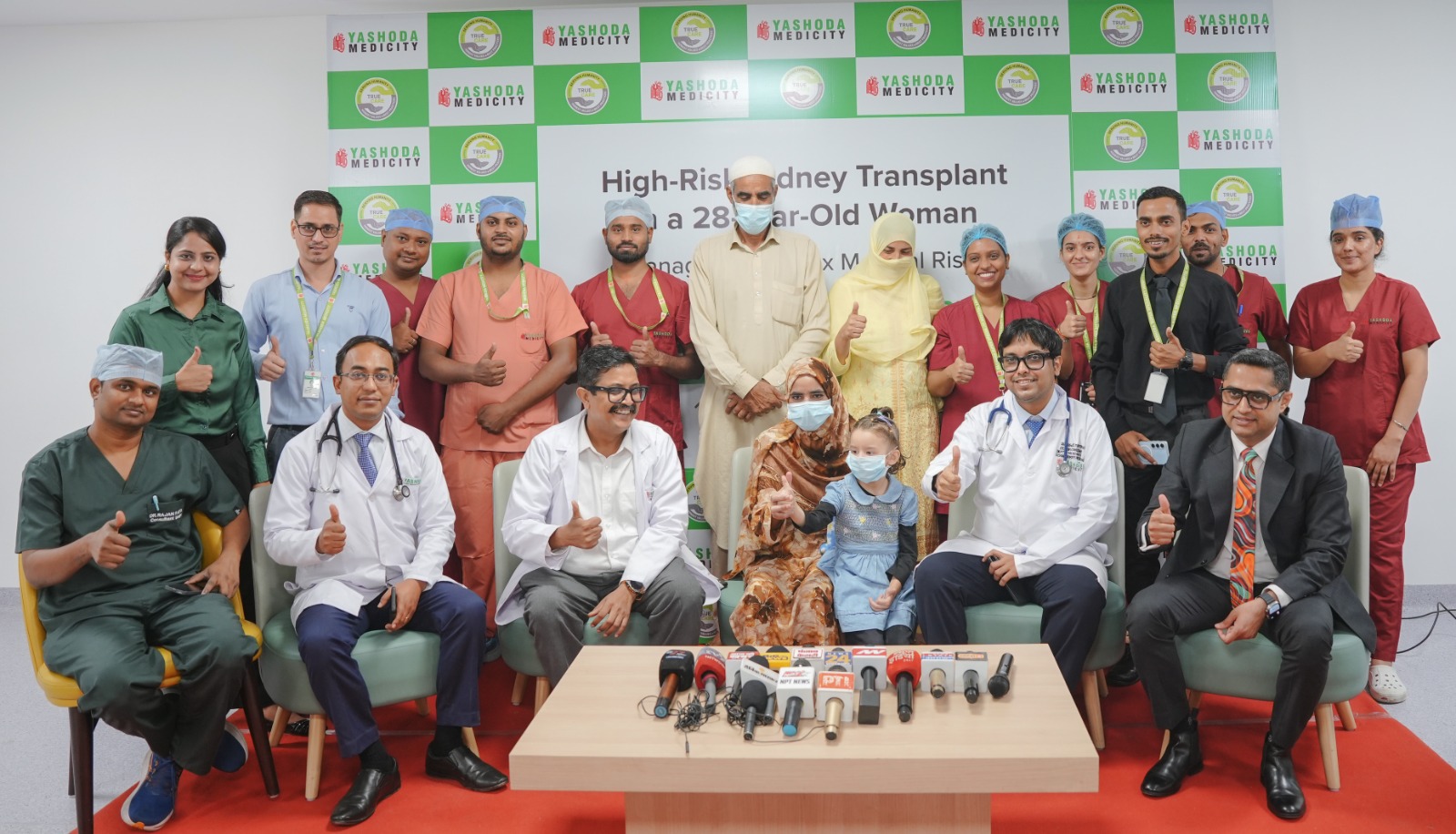
 The Team Meticulously averted the Risk of Thrombosis, Husband was Donor
Delhi/NCR : Doctors at Yashoda Medicity have successfully performed a high-risk kidney transplant in a 28-year-old woman with Antiphospholipid Antibody Syndrome (APLA), a serious autoimmune disorder that significantly increases the risk of potentially life- threatening blood clots, who also had Donor Specific Antibodies (DSA) resulting from previous sensitisation. The transplant, performed on 18 August 2026, involved an ABO-compatible kidney donated by the woman’s husband and required extensive preparation to manage the risk of blood clotting as well as potential immunological complications.
The patient, Mrs. Morifat Rashid, was diagnosed with APLA secondary to Systemic Lupus Erythematosus (SLE) around 1.5 years ago and subsequently developed Chronic Kidney Disease (CKD). She was being treated with warfarin for her increased tendency for blood clotting. Her medical history of three abortions and multiple blood transfusions had also contributed to sensitisation and the presence of DSA, adding a second major challenge to the transplant.
A multidisciplinary team at Yashoda Medicity, comprising Dr. Vaibhav Saxena, Senior Director, Urology, Uro-Oncology, Robotics & Renal Transplant; Dr. Kuldeep Aggarwal, Associate Director, Urology, Uro-Oncology, Robotics & Renal Transplant; Dr. Prajit Mazumdar, Senior Consultant, Nephrology & Renal Transplant; and Dr. Indrajit G. Momin, Senior Consultant, Nephrology & Renal Transplant, planned the procedure to address both risks before transplantation. To reduce the risk associated with DSA, Mrs. Rashid underwent three sessions of plasmapheresis along with IVIg therapy before the transplant. To manage the risk of thrombosis associated with APLA, her regular warfarin was stopped five days before transplantation and anticoagulation was managed with heparin.
Dr. Vaibhav Saxena, Senior Director, Urology, Uro-Oncology, Robotics & Renal Transplant at Yashoda Medicity, said, “This was a technically challenging transplant given the patient’s high risk of thrombosis. Maintaining blood flow through the transplanted kidney was critical, so the team carefully planned the timing of anticoagulation around surgery and close postoperative monitoring. The good urine output and stable graft function following the procedure reflect the importance of coordinated management between the transplant surgery and nephrology teams in such high-risk cases.”
Dr. Prajit Mazumdar, Senior Consultant, Nephrology & Renal Transplant at Yashoda Medicity, said, “Kidney transplantation in a
patient with APLA requires meticulous planning as the condition significantly increases the risk of thrombosis, while Donor Specific Antibodies add an immunological challenge. In this case, both risks were carefully managed through planned anticoagulation, plasmapheresis and IVIg therapy. The patient had good urine output and stable graft function following the transplant and continues to do well on regular anticoagulation and immunosuppressive therapy.”
Mrs. Morifat Rashid, the 28-year-old kidney transplant recipient, said, “The past few years have been extremely difficult, and undergoing a kidney transplant with so many risks was a deeply challenging experience for my family and me. Having my husband come forward as my donor gave me immense strength and hope. I am deeply grateful to the doctors and the entire team at Yashoda Medicity for the care, planning, and support throughout my treatment. Today, being able to live with good kidney function means a great deal to me, and I am thankful to everyone who stood by me through this journey.”
Following the transplant, Mrs. Rashid had good urine output and stable allograft function. Anticoagulation was subsequently bridged back to warfarin, with the dose adjusted through regular PT-INR monitoring. She was discharged after an uneventful recovery with stable allograft function and a serum creatinine of 0.7 mg/dL. Mrs. Rashid is currently doing well with good allograft function, with her latest serum creatinine at 0.9 mg/dL. She remains on triple immunosuppressive therapy along
with warfarin-based anticoagulation and continues to be under regular medical follow-up.
The case demonstrates the additional complexity involved in kidney transplantation when thrombotic and immunological risks coexist. APLA can increase the tendency of blood to clot and raise the possibility of renal artery or renal vein thrombosis, while DSA can increase the risk of antibody-mediated complications. In this case, addressing both risks before transplantation and maintaining close monitoring after the procedure enabled the team at Yashoda Medicity to achieve stable graft function.