New Delhi: India’s medical devices industry is on a remarkable growth trajectory, with projections indicating it will reach $50.1 billion by 2030, according to a recent report from Rubix Industry Insights dated February 2026. This represents a more than threefold increase from its current valuation of $15.2 billion in 2025, driven by a robust compound annual growth rate (CAGR) of 26.9% over the 2025–2030 period—one of the fastest growth rates observed globally in the sector.
The report, titled “Rubix Industry Insights – Medical Devices February 2026,” highlights that the market stood at approximately $12 billion in 2024 before climbing to $15.2 billion in 2025. Year-by-year forecasts include $19.3 billion in 2026, $24.5 billion in 2027, $31.1 billion in 2028, $39.5 billion in 2029, and ultimately $50.1 billion by 2030. This explosive expansion positions India to potentially increase its global market share from the current 1.65% to 10–12% in the coming decades.
Key Drivers Fueling the Surge
Several factors are propelling this rapid ascent:
- Government Initiatives and Policies: The National Medical Devices Policy (NMDP) 2023 aims to establish India as a global manufacturing hub, emphasizing affordability, innovation, quality, and reduced import dependence. The Production Linked Incentive (PLI) Scheme, with an outlay of INR 34.2 billion through FY2026-27, has supported 22 greenfield projects by September 2025, enabling production of 55 high-value products such as MRI/CT scanners, linear accelerators, and implants. Additional schemes include the Promotion of Medical Devices Parks (three parks approved in Uttar Pradesh, Madhya Pradesh, and Tamil Nadu, with 34 units under construction as of November 2025) and MedTech Mitra for regulatory and clinical support.
- Rising Investments and Private Sector Expansion: Global players are committing significant capital, including Siemens Healthineers, Philips, OMRON, Wipro GE Healthcare, and others establishing manufacturing facilities. Private equity and venture capital funding in the sector has surged, with notable deals like KKR’s investments in Healthium Medtech. Hospital expansions are adding over 34,000 beds by FY2029, while diagnostic labs (e.g., Dr Lal PathLabs, Agilus) are scaling rapidly, boosting demand for devices.
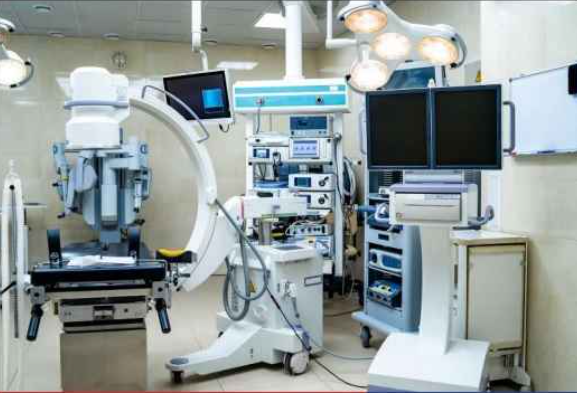
- Indigenous Innovation: Breakthroughs include indigenous MRI scanners (Voxelgrids, SAMEER), artificial hearts (IIT Kanpur’s Hridayantra), robotic systems (Meril Life Sciences), and tele-robotic surgery units. These efforts address high-end segments traditionally dominated by imports.
- Trade Developments: An interim India–US trade agreement in February 2026 reduced US import tariffs on Indian medical devices from 50% to 18%, enhancing export competitiveness. Exports reached $4.1 billion in FY2025 (10% CAGR from FY2023), while imports stood at $8.6 billion, underscoring ongoing reliance on foreign supply for advanced tech (70–80% of demand met via imports, especially from the US and China).
Current Landscape and Challenges
India ranks as the fourth-largest medical devices market in Asia and among the top 20 globally, with around 800 domestic manufacturers. The sector remains fragmented, strong in low- to mid-tech areas like consumables and disposables (which lead exports at 47%), but heavily import-dependent for electro-medical equipment (60% of imports). Per capita spending remains low at $3, compared to the global average of $47, reflecting affordability and infrastructure gaps.
Challenges include high import reliance for high-tech devices, scale limitations among domestic firms, and competitive pressures from easier imports post-tariff reductions. However, policies target reducing imports below 50% in the next five years.
Looking Ahead
With expanding healthcare infrastructure, rising chronic diseases, an aging population, growing medical tourism, and genomics-led diagnostics, the sector is poised for transformation. As Shri. Pawan Chaudhary, Chairman of the Medical Technology Association of India, noted: “The medical devices scheme will provide healthcare sovereignty… it is very important for us to be self-reliant in healthcare.”
This Rubix report underscores India’s potential to evolve from a major importer to a significant global MedTech player, supported by proactive policies and increasing domestic capabilities. The $50 billion milestone by 2030 signals a new era of self-reliance and innovation in India’s healthcare landscape.