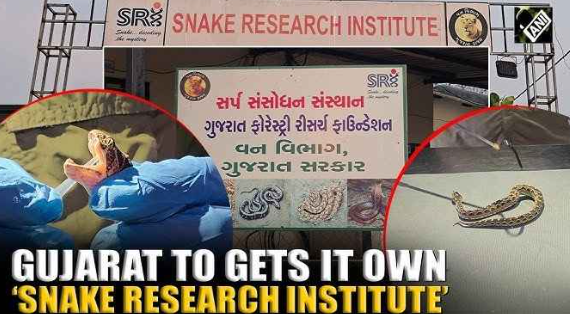
Gandhinagar: – In a groundbreaking move to tackle one of India’s most pressing public health challenges, the Gujarat government has announced plans to produce its own region-specific antivenom, tailored to the venom profiles of snakes native to the state. This initiative, spearheaded by the newly established Snake Research Institute (SRI) in Dharampur, Valsad district, aims to significantly reduce snakebite-related fatalities, which claim thousands of lives annually in rural Gujarat. Officials say this targeted approach addresses a critical gap in current treatments, where generic antivenoms often fall short due to regional variations in snake venom composition.
Snakebites remain a silent killer in India, with the country accounting for nearly half of global snakebite deaths – an estimated 50,000 lives lost each year, according to federal data. In Gujarat alone, the annual snakebite death rate stands at 3.5 per 100,000 people, translating to around 2,100 fatalities and between 67,000 to 134,000 bites yearly, based on health department guidelines and hospital records. These incidents disproportionately affect farmers, laborers, and rural communities, where access to timely medical care is limited. The “big four” venomous snakes – Indian Cobra, Common Krait, Russell’s Viper, and Saw-scaled Viper – are responsible for the majority of these cases in the state, with bites often occurring at night or early morning in agricultural fields.
Developmental Progress: From Venom Collection to Antivenom Production
The push for region-specific antivenom in Gujarat marks a significant advancement in snakebite management. The SRI, operational since its setup by the state government, has already made strides in this direction. The institute houses over 460 venomous snakes in a state-of-the-art serpentarium, adhering strictly to World Health Organization (WHO) guidelines for venom extraction and processing.
A key milestone was achieved this week with an e-auction of high-quality venom extracted from local snakes. The auction fetched impressive prices: Rs 44,000 per gram for Cobra venom and Rs 56,500 per gram for Saw-scaled Viper venom, among others. This venom, processed into powdered form, will be supplied to pharmaceutical companies for antivenom manufacturing. Dr. DC Patel, Vice-Chairman of SRI, emphasized the rationale: “Snake venom varies geographically, making antivenoms from distant regions less effective. By sourcing venom from Gujarat’s snakes, we’re creating a product optimized for local needs.”
The institute’s expansion plans underscore the project’s momentum. The government has allocated 2.25 hectares for a world-class SRI campus, with a proposed Rs 11.68 crore investment for infrastructure upgrades. Beyond production, SRI has trained over 1,495 doctors and 300 snake rescuers, enhancing rural healthcare response and public awareness. This aligns with India’s National Action Plan for Prevention and Control of Snakebite Envenoming (NAPSE), launched in 2024, which targets halving snakebite deaths by 2030 through improved surveillance, antivenom availability, and research.
Nationally, similar efforts are underway. Indian scientists are characterizing regional venom variations to develop geography-specific antivenoms, with companies like VINS Bio in Hyderabad already producing monovalent and polyvalent versions for different regions. Studies from institutions like AIIMS Jodhpur highlight the inefficacy of standard polyvalent antivenoms against local viper variants, reinforcing the need for such innovations.
Regional Demand: A Public Health Imperative
Demand for effective antivenom in Gujarat is acute, driven by the state’s agrarian economy and diverse ecosystems. Rural areas in districts like Valsad, Surat, and Vadodara report high incidence rates, with victims often facing delays in treatment due to poor infrastructure. A 2013 study in Vadodara found that 71% of victims were from rural backgrounds, with 64% bitten on lower limbs during nighttime activities. Tragic cases, such as a pregnant tribal woman in Gujarat who died en route to a hospital in 2025 after being carried 5 km due to inaccessible roads, underscore the urgency.
Broader Indian trends amplify this need. From 2000 to 2019, India saw 1.2 million snakebite deaths, with Gujarat among states like Rajasthan and Andhra Pradesh bearing a disproportionate burden. Experts from organizations like The Liana Trust advocate for antivenoms beyond the “big four,” as lesser-known species contribute to fatalities. In Assam and western India, studies call for region-specific solutions to improve treatment outcomes.
Profitability vs. Public Attention: A Genuine Lifesaver or Political Ploy?
While the initiative has garnered praise, questions arise about its economic viability and motives. Antivenom production is notoriously low-profit, with high costs for venom collection, animal immunization (typically horses), purification, and regulatory compliance. Globally, the anti-venom market is projected to reach $1.95 billion by 2032, growing at 6.46% CAGR, but in low-income regions like sub-Saharan Africa and Southeast Asia, it’s hampered by low procurement investment and market decline. In India, production is often subsidized by governments, as seen in ASEAN countries where antivenoms are treated as essential drugs with minimal profit margins.
Recombinant antivenoms – lab-produced alternatives – could lower costs to $20-225 per treatment for monovalent types, compared to $56-640 for traditional ones, but scaling remains challenging. Critics argue that without strong demand and economies of scale, profitability is elusive, leading some manufacturers to exit the market. However, Gujarat’s model, backed by state funding and aligned with national goals, appears driven by public health needs rather than profit. The venom auction’s success indicates potential revenue streams, but experts like those from the Global Snakebite Taskforce (GST) stress that antivenom’s true value lies in saving lives, not generating returns.
Far from a mere publicity stunt, this development addresses a long-standing expert consensus on the need for localized antivenoms. As Dr. Yogesh Jain of GST notes, India’s snakebite crisis demands innovative, region-focused solutions to overcome challenges like poor antivenom efficacy and access. With SRI’s progress, Gujarat could set a precedent for other states, potentially saving thousands of lives while proving that public investment in neglected diseases yields societal dividends beyond financial gain.
Health officials urge immediate first aid for snake bites: immobilize the limb, avoid tourniquets or incisions, and seek medical help promptly. As this antivenom rolls out, it promises a safer future for Gujarat’s vulnerable populations.
Source : DrugsControl Media Services