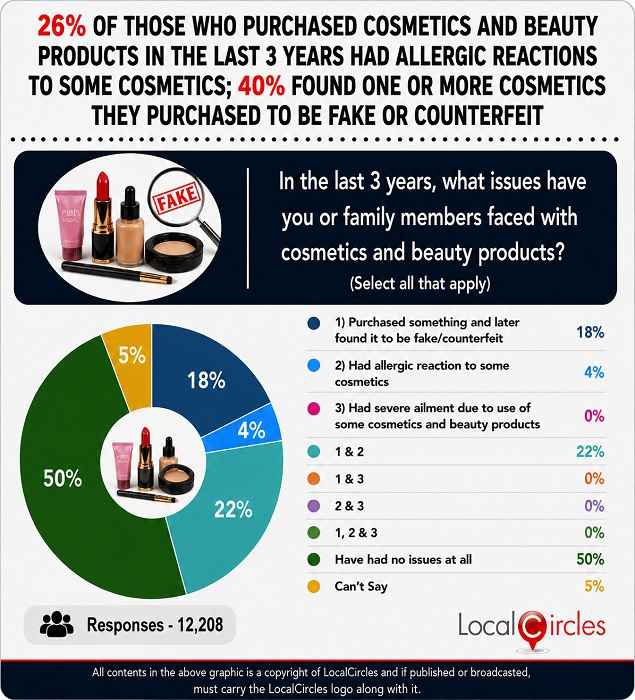
New Delhi: Counterfeit cosmetics are no longer a problem confined to a few street markets or isolated raids. A new nationwide consumer survey has delivered another stark warning: 40% of consumers surveyed who purchased cosmetics and beauty products during the last three years said they had received one or more products that turned out to be fake or counterfeit, while 26% reported an allergic reaction to one or more cosmetics. The findings have once again highlighted a regulatory problem that consumer organisations, enforcement agencies and independent observers have been flagging for years.
The latest findings were released by LocalCircles on August 14, 2026, following a survey of more than 23,000 consumers across 318 districts of India. The survey found that 18% of respondents had purchased a cosmetic that they later discovered was fake or counterfeit, while another 22% had experienced both counterfeiting and an allergic reaction. Taken together, 40% reported having purchased at least one counterfeit cosmetic and 26% reported an allergic reaction. Significantly, no respondent in this particular survey reported a severe ailment caused by cosmetics, although the survey did identify a substantial overlap between counterfeit purchases and allergic reactions.
The figures are particularly disturbing because cosmetics are applied directly to the skin, hair, eyes and, in some cases, lips and other sensitive areas. Unlike an ordinary counterfeit consumer product, a fake cream, sunscreen, lipstick, hair-removal product, serum or skin-lightening preparation can expose consumers to unknown ingredients, contaminants, incorrect concentrations, heavy metals or microbiological contamination. The consumer generally has no laboratory capability to distinguish an authentic product from a sophisticated counterfeit merely by examining its packaging.
The online marketplace has emerged as the biggest reported channel for counterfeit cosmetics. LocalCircles found that 23% of consumers who encountered counterfeit cosmetics had purchased them through an online platform, app or website. Beauty, cosmetics and general stores accounted for 18%, while local stores or market stalls accounted for 14%. Department stores accounted for 9%, and company stores and direct sellers or individuals each accounted for 5%. The survey therefore points towards a major vulnerability in the modern distribution chain: the consumer may be purchasing a product through a professionally designed website or mobile application, but the actual source of the product can remain difficult to establish.
This is where the latest survey becomes more than another consumer poll. It exposes a fundamental gap between product availability and product authenticity. A cosmetic may appear to be branded, sealed and professionally packaged, yet those characteristics do not establish that the product is genuine, lawfully manufactured or legally imported. LocalCircles has therefore recommended a system under which every cosmetic sold in India should carry a unique, scannable authentication code enabling consumers to verify its identity, manufacturing and expiry details. It has also called for stronger seller due diligence by e-commerce and quick-commerce platforms, disclosure of seller and licence details, a national database of banned, recalled and Not of Standard Quality cosmetics, regular sampling of online and offline markets, and a single-window mechanism for reporting suspected counterfeit products and adverse reactions.
The warning is not new — enforcement cases keep proving it
What makes the latest consumer survey particularly significant is that it comes against a continuing stream of enforcement cases reported by DrugsControl Media Services and other sources. In May 2026, authorities in Alwar, Rajasthan, busted a racket involving duplicate cosmetics bearing the names of popular HUL brands, with fake Lakme lipsticks, kajal, foundation, face creams and other products seized from warehouses.
In Ahmedabad earlier this month, police seized more than 10,000 counterfeit soaps and face-wash products valued at approximately ₹11.68 lakh from a warehouse. In Patna, police also raided premises where counterfeit cosmetic products and related materials were recovered. In April, Delhi Police Crime Branch busted an illegal unit allegedly manufacturing fake Veet hair-removal cream.
The problem is not restricted to one State. In 2025, Gujarat’s FDCA reported seizures of fake cosmetics manufactured without government licences, while Kerala’s Drugs Control Department launched repeated enforcement operations against counterfeit beauty products under Operation Soundarya. In Surat, counterfeit Cetaphil and other cosmetic products worth more than ₹26 lakh were reportedly seized in July 2025.
These cases are important not because every seized product necessarily represents a national market share, but because they demonstrate that counterfeit cosmetics are being manufactured, relabelled, stocked and distributed through multiple channels — including online channels.
The health risk can be far greater than a fake label
The issue becomes still more serious when counterfeit cosmetics contain hazardous substances. The latest LocalCircles release cites the case of women in Nagpur who reportedly developed kidney disorders after using a Pakistan-made skin-lightening product, Goree Beauty Cream. According to the Maharashtra FDA findings cited in the release, samples contained mercury at levels reported to be 752 times the permissible limit. The department also flagged other beauty creams containing excessive mercury and lead and ordered action against their sale and distribution.
The Maharashtra FDA’s wider enforcement campaign during June 2026 reportedly resulted in raids at 34 manufacturing units and action involving illegal drugs, medical products and cosmetics valued at ₹4.12 crore. The department said 787 samples were tested, 35 were declared Not of Standard Quality, nine FIRs were registered and two arrests were made.
This illustrates why the counterfeit cosmetics issue should not be treated merely as an intellectual-property dispute between a brand owner and an imitator. When a counterfeit product contains an undeclared chemical, heavy metal, contaminated raw material or an unknown active ingredient, the issue becomes one of public health and regulatory enforcement.
India already has a regulatory framework — the question is implementation
India is not without laws governing cosmetics. The Drugs and Cosmetics Act, 1940 and the Cosmetics Rules, 2020 provide the regulatory framework. CDSCO states that manufacture of cosmetics is regulated through inspection and licensing by State Licensing Authorities, while import of cosmetics is regulated through registration by the Central Licensing Authority. CDSCO also states that imported cosmetics must be registered and that cosmetics manufactured or imported into India must comply with prescribed standards of quality and safety. The Cosmetics Rules further prohibit false or misleading claims.
The regulatory architecture therefore exists. The more uncomfortable question is whether market surveillance, testing, traceability and enforcement are keeping pace with the speed and scale of cosmetic distribution.
The growth of e-commerce, social-commerce, influencer marketing and quick-commerce has fundamentally changed the supply chain. A counterfeit manufacturer no longer necessarily needs a conventional shopfront. Products can be promoted through social media, sold through third-party sellers and delivered directly to consumers. The LocalCircles survey’s finding that online platforms were the single largest reported source of counterfeit cosmetics is therefore a warning that conventional inspection models may no longer be sufficient.
Repeated wake-up calls from DrugsControl Media Services
For years, DrugsControl Media Services has continued to report raids, seizures and cases involving fake cosmetics across different States. The pattern is remarkably consistent: police or State drug authorities receive information, a brand owner or enforcement agency identifies suspected counterfeiting, premises are raided, products are seized and criminal proceedings follow.
But the recurring question remains: How many counterfeit products enter the market before a raid takes place?
A seizure is evidence of enforcement, but it is not evidence that the market has been made safe. If a single warehouse contains thousands of counterfeit products, the more important regulatory question is how many similar consignments have already reached consumers and how many remain undetected in other warehouses, retail shops, online inventories, salons and homes.
The latest LocalCircles survey effectively provides the consumer-side evidence to accompany the enforcement-side evidence. Regulators are discovering counterfeit products through raids; consumers are discovering them after purchase. The two pictures are increasingly converging.
Regulatory silence cannot become the default response
One of the most troubling aspects of the counterfeit cosmetics problem is the absence of sustained public regulatory communication following many such incidents. Raids receive publicity, but consumers are rarely provided with a comprehensive, searchable and regularly updated national picture of which cosmetic products have been found counterfeit, adulterated, misbranded, unsafe, unlicensed or otherwise non-compliant.
This is an area where transparency could materially improve consumer protection.
If a particular cosmetic has been found to contain excessive mercury or lead, consumers should not have to discover the information through a newspaper report months later. If a cosmetic registration has been cancelled, the information should be easily accessible to consumers and online marketplaces. If a batch has been recalled or declared unsafe, platforms should be technically capable of removing the product from their listings rather than waiting for consumers to complain.
CDSCO’s current public notices already demonstrate that cosmetic registrations and products can be cancelled or withdrawn. Its public notices for 2026 include cancellation and surrender of cosmetic registration certificates and other regulatory actions involving imported cosmetics. The next logical step is to transform such regulatory information into a consumer-facing national safety and authenticity system.
From periodic raids to continuous surveillance
India’s cosmetics regulatory strategy needs to move from a largely reactive model to a continuous post-market surveillance system. Random sampling should not depend exclusively on complaints, intelligence or brand-owner intervention. Online listings, physical markets, salons, wholesalers, distributors, importers and manufacturing units should all form part of a risk-based surveillance programme.
The challenge is especially acute for products sold at extraordinary discounts. A cosmetic offered at a fraction of its normal market price should not automatically be presumed counterfeit, but it should trigger stronger scrutiny where the seller, supply chain or product documentation cannot be authenticated.
E-commerce platforms should also carry a greater share of responsibility. If a marketplace allows third-party sellers to offer cosmetics to millions of consumers, verification cannot stop at collecting a seller’s basic identity documents. Platforms should be required to maintain traceable records of the manufacturer, importer, licence or registration details, batch number, manufacturing and expiry information and source of supply.
The consumer should not be expected to become a drug inspector.
A national cosmetics authenticity system is overdue
The LocalCircles proposal for a unique scannable authentication code deserves serious examination by the Ministry of Health and Family Welfare, CDSCO, State Drug Controllers and the Department of Consumer Affairs. Such a system could combine product identity, manufacturer/importer information, batch details, expiry status, registration information and regulatory alerts in a single verification mechanism.
A consumer scanning a QR code before applying a cosmetic should ideally be able to know: Who made it? Where was it made? Is the manufacturer/importer authorised? Is the product registered where required? Is the batch genuine? Has it been recalled or flagged? Is the product past its expiry date?
Such a system would not eliminate counterfeiting by itself, because counterfeiters can also copy QR codes. But when combined with encrypted or dynamically verifiable authentication, supply-chain traceability and enforcement, it could significantly increase the difficulty of selling sophisticated counterfeits.
The regulator must answer the bigger question
The latest survey should not be dismissed as another NGO or citizen-survey report. It should be treated as a regulatory intelligence signal.
LocalCircles has surveyed more than 23,000 consumers across 318 districts. Forty percent reported receiving counterfeit cosmetics and 26% reported allergic reactions. The survey does not establish that every allergic reaction was caused by a counterfeit product, nor does it constitute laboratory evidence of the prevalence of counterfeit cosmetics in the entire Indian market. But it does establish a disturbing level of consumer exposure and provides a clear indication of where consumers believe the vulnerabilities lie.
The enforcement record makes the warning harder to ignore. Fake cosmetics have been repeatedly found in warehouses, manufacturing units, retail shops and online supply chains in Rajasthan, Gujarat, Maharashtra, Delhi, Kerala, Bihar and other parts of the country.
The question for India’s regulators is therefore no longer whether counterfeit cosmetics exist. They clearly do.
The question is whether the regulatory system is capable of detecting them before they reach the consumer, rather than after a raid, an adverse reaction, a police complaint or a brand owner’s intervention.
India has entered an era in which a consumer can order a cosmetic from a mobile phone and receive it within hours. Regulatory surveillance cannot continue to operate as if cosmetics are sold only across a physical shop counter.
Source : LocalCircles