
New Delhi: India ranks among the top contributors globally in reporting adverse events, Drugs Controller General of India (DCGI) Dr Rajeev Raghuvanshi said on Wednesday.
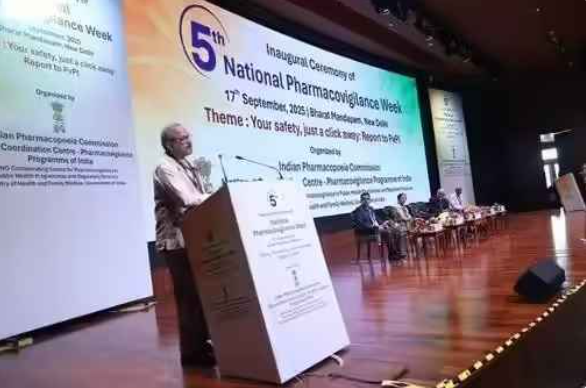
He made the remarks at an event as he highlighted the growing role of pharmacovigilance in safeguarding patient health. The Indian Pharmacopoeia Commission (IPC), functioning as the National Coordination Centre for the Pharmacovigilance Programme of India (NCC-PvPI), inaugurated the 5th National Pharmacovigilance Week (NPW) at the Bharat Mandapam Convention Centre.
The National Pharmacovigilance Week is being observed from September 17 to September 23 under the theme ‘Your Safety, Just a Click Away: Report to PvPI’.
The week-long campaign aims to sensitise healthcare professionals, regulators, researchers and the public to actively report adverse drug reactions (ADRs) through simplified digital platforms.
“Initiation of National Pharmacovigilance Week in the journey of pharmacovigilance in the country has changed the course of pharmacovigilance,” Dr Raghuvanshi said while addressing the gathering.
“With the number of reports, we ranked among the top contributors globally in reporting adverse events”, he added.
Highlighting the significance of pharmacovigilance, Dr Raghuvanshi emphasised that “since the inception of the programme, the majority of reports have come from healthcare professionals, whereas meaningful impact can only be achieved when patients themselves actively participate in reporting”.
He added that despite the availability of significant data for analysis, its optimum utilisation in strengthening pharmacovigilance is still lacking.
Furthermore, he also said, “The content of pharmacovigilance needs to be changed as the context has changed in the country. It is now that pharmacovigilance has a strong base and policies are being designed and regulated.”
He said, “We need to develop a culture of curiosity within the organisation, not a culture of apprehension for better results.”
“What is needed is the smart integration of technology and innovative approaches to drive differential thinking,” he added.
Underlining the strides made in the direction of pharmacovigilance, Dr Raghuvanshi said, “We have been successful in bringing IPC and IP to the highest agenda of this country.”
On this occasion, the IPC unveiled a series of new initiatives, including the launch of a short film on PvPI, a pharmacovigilance comic published in multiple vernacular languages to enhance public awareness and a new online reporting platform designed for easy access through a QR code.





%20In%20Drug%20Development)