
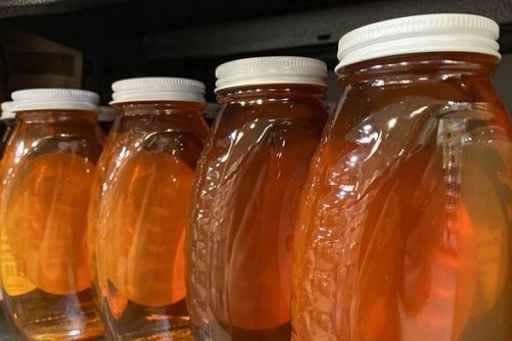
London: Scientists in the UK have developed new ways to analyse honey to check for adulteration, in some cases without opening the jar.
There has been a lot of attention on honey fraud in recent years amid reports that products are on the market that have been adulterated with cheap syrups, made from materials like rice and corn. Last year, an EU study found that 46 per cent of 320 honey samples tested were considered suspect, a big increase on an earlier assessment carried out in 2017 which pointed to a rate of 14 per cent.
Scientists led by Cranfield University say they have successfully tested two new methods to authenticate UK honey quickly and accurately.
One project led by Dr Maria Anastasiadi, a lecturer in bioinformatics at Cranfield, used a specialist light analysis technique called non-invasive spatial offset Raman spectroscopy (SORS) to detect fake honey in its original packaging.
The technique rapidly identified the ‘fingerprint’ of each ingredient in the product, and the scientists combined this technique with machine learning to successfully detect and identify sugar syrups from various plant sources.
It proved to be “highly accurate in detecting sugar syrups present in the honey,” according to the researchers, and the portability of the equipment needed to carry out the testing means it could be suitable for testing honey along the supply chain.
The study, conducted with the Food Standards Agency (FSA) and Science and Technology Facilities Council (STFC) in the UK, has been published in the journal Foods.
A second approach based on DNA barcoding was used in a second study, in collaboration with the FDA and the Institute for Global Food Security at Queen’s University of Belfast. The researchers tested UK samples of honey and spiked them with corn and rice syrups produced in a range of countries, finding that it was possible to detect adulteration at levels down to 1%.
While DNA methods are already well-established in the food industry for identifying plant species in products, they haven’t been widely used to examine honey authenticity, said Dr Anastasiadi.
“Our study showed that this is a sensitive, reliable and robust way to detect adulteration and confirm the origins of syrups added to the honey,” she added.




%20In%20Drug%20Development)