Lucknow: Chief Minister Yogi Adityanath on Sunday said that Uttar Pradesh is not merely a state with a population of 25 crore but has also emerged as the country’s largest hub for addressing the healthcare needs of neighboring states and other parts of the country.
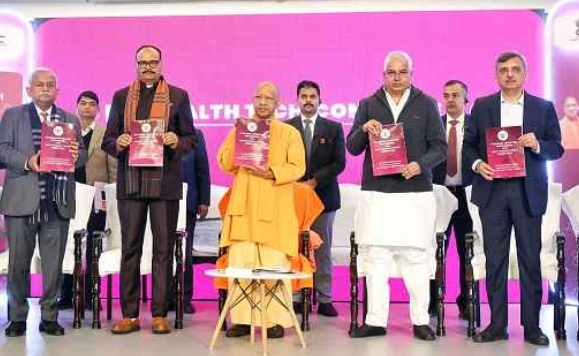
Attending the UP HealthTech Conclave in Lucknow, the CM launched UP-IMRAS, the integrated medical research application system developed for the residents of Uttar Pradesh, through which clinical trials before launching pharmaceutical products and medical devices would be done in a seamless manner.
“The state govt is working to transform UP into a national and global centre for medical technology, healthcare innovation and pharmaceutical manufacturing. Before 2017, UP had only 40 medical colleges that were run either by govt or private players. Currently, we have 81 colleges that are catering to the needs of the medical students. Two AIIMS (Rae Bareli and Gorakhpur), 100 district hospitals, and hundreds of community health centres and primary healthcare centres are catering to lakhs of people on a daily basis,” he said.
Referring to the successful results of the PM Arogya scheme, the CM said that financial help was being provided to needy families who found it difficult to afford healthcare services in the past.
“Ayushman cards were provided to 5.5 crore families, helping them to cover treatment costs of up to Rs 5 lakh. Families which could not be covered under the central scheme are being supported through UP CM Jan Arogya scheme without any discrimination,” he said.
“Through regular monitoring and teamwork, UP significantly reduced infant mortality rate by managing institutional deliveries. Special drives were conducted to reach out to tuberculosis patients. Diseases such as encephalitis, dengue, malaria, chikungunya, and kala-azar were also controlled through sustained campaigns. No deaths were recorded due to encephalitis over the past two years, which is a big achievement,” he said.
The CM said that, as the next step, private players would come up with platforms to screen rural populations early on with the help of artificial intelligence and technology. “People from villages have to cover 30-40 km to reach a hospital which has specialised facilities,” he said.
Pointing to growing advantages in the field, Yogi said that the medical device park along the Yamuna Expressway in Greater Noida and the pharmaceutical park in Lalitpur would be a game-changer.
Assuring the stakeholders of time-bound approval and support at every stage, Yogi urged private players to explore the vast opportunities the state offers.
Deputy chief minister and health minister Brajesh Pathak, principal secretary of the department Amit Ghosh, and Drugs Controller of India Rajiv Raghuvanshi were present.
Yogi also unveiled a book dedicated to standard operating procedures based on the institutional ethics committee, which focuses on the 22 procedures required to ensure uniformity and compliance pertaining to clinical trials.