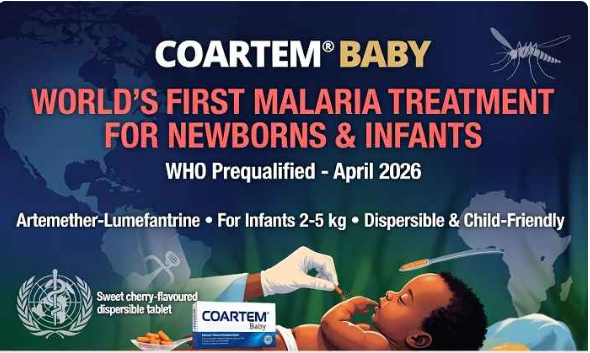
New Delhi– In a landmark development for global child health, the World Health Organization (WHO) has granted prequalification to Coartem® Baby (artemether-lumefantrine), the first and only antimalarial medicine specifically developed and approved for newborns and young infants weighing 2 to 5 kilograms (approximately 4.4 to 11 pounds).
Announced on 24 April 2026 by Novartis and the Medicines for Malaria Venture (MMV), this prequalification marks a historic breakthrough that closes a long-standing treatment gap for one of the world’s most vulnerable populations. Malaria remains a leading cause of death among children under five in sub-Saharan Africa, with infants under 2–5 kg previously left without any approved, age-appropriate therapy.
Key Features of Coartem Baby
Formulation: Dispersible tablets with a pleasant sweet cherry flavour that dissolve easily in breast milk, water, or other liquids. This child-friendly design allows precise dosing via oral syringe or spoon, significantly reducing the risk of dosing errors that occurred when adult tablets were crushed for infants.
Active Ingredients: Fixed-dose combination of artemether and lumefantrine – the same proven artemisinin-based combination therapy (ACT) used in older children and adults, but optimised for the smallest patients.
Indication: Treatment of acute, uncomplicated Plasmodium falciparum malaria in newborns and infants 2–5 kg.
Also known as: Riamet® Baby in certain markets.
Development and Clinical Evidence
Coartem Baby was developed through a close collaboration between Novartis and MMV, with scientific and financial support from the PAMAfrica consortium (co-funded by the European & Developing Countries Clinical Trials Partnership and the Swedish International Development Cooperation Agency).
The approval pathway was supported by the CALINA study – a Phase 2/3 clinical trial conducted across eight African countries (Burkina Faso, Democratic Republic of Congo, Kenya, Mali, Nigeria, Zambia and others). The trial demonstrated that the new infant-specific dose achieved therapeutic blood levels comparable to those in older children, with a favourable safety profile and high efficacy. Swissmedic granted the first regulatory approval in July 2025, paving the way for rapid national approvals in participating African nations.
Prior to this formulation, healthcare providers had no choice but to split or crush adult Coartem tablets, leading to inaccurate dosing, potential under- or over-treatment, and increased risk of toxicity or treatment failure in the youngest patients.
Global Health Impact
WHO prequalification now enables large-scale public-sector procurement and distribution through UNICEF, the Global Fund, and national malaria control programmes. Novartis has committed to making Coartem Baby available on a largely not-for-profit basis in malaria-endemic countries to maximise access.
Experts have welcomed the development:
“Coartem Baby is the first malaria treatment tailor-made for infants that is well tolerated and gives us confidence,” said a senior MMV representative.
“This new child-appropriate formulation addresses that issue by offering a safe, properly dosed, and easy-to-administer treatment for the most vulnerable age group,” noted Dr Jane Achan, paediatric infectious disease specialist and principal advisor at the Malaria Consortium.
With approximately 30 million babies born each year in high-burden malaria regions of sub-Saharan Africa, this innovation is expected to save thousands of young lives and strengthen paediatric malaria care across the continent. Rollout is anticipated in the eight trial countries and beyond in the coming months.
Implications for India and Global South
While India has made remarkable progress in malaria elimination, the availability of Coartem Baby sets a new global standard for paediatric formulations. Indian paediatricians, neonatologists, and public health programmes can draw lessons from this model of targeted innovation for vulnerable populations. The dispersible, breast-milk-compatible format may also inspire similar advancements for other essential medicines used in Indian newborns.
DrugsControl Media Services will continue to monitor the global rollout of Coartem Baby and any subsequent regulatory developments in India or other high-burden countries.
References (key sources):
Novartis & MMV Press Releases (24 April 2026)
WHO Prequalification Announcement
CALINA Study Results (PAMAfrica Consortium)