New Delhi: Despite stringent provisions under the Drugs and Cosmetics Act, 1940 and the Narcotic Drugs and Psychotropic Substances (NDPS) Act, 1985, illegal diversion and trafficking of prescription medicines continues to spread across India at an alarming scale. In recent weeks alone, police and enforcement agencies in multiple states have seized huge consignments of Codeine-based cough syrups, Tramadol capsules, Pregabalin, Tapentadol, psychotropic tablets, and other habit-forming medicines allegedly being diverted into the illicit drug market.
The repeated seizures have once again exposed the widening gap between legal regulation on paper and ground-level enforcement, where scheduled medicines are allegedly sold openly without prescriptions, transported through courier and transport networks, and smuggled across interstate and international borders with relative ease.
STF Charge Sheet Reveals Large Codeine Diversion Network
One of the most significant recent developments emerged from Uttar Pradesh, where the Special Task Force (STF) reportedly filed a detailed charge sheet in a major Codeine cough syrup diversion case linked to an interstate syndicate. Investigators alleged that huge quantities of cough syrup containing Codeine phosphate were diverted from legitimate pharmaceutical supply channels into the illegal narcotics trade.
According to reports, the network allegedly involved procurement, transportation, storage, and supply of cough syrup to drug peddlers and illegal distribution chains. Enforcement officials suspect that diverted pharmaceutical products are increasingly replacing traditional narcotic substances due to easy availability and comparatively weaker monitoring mechanisms.
Large Seizures Reported Across Bihar, Uttar Pradesh, Punjab, Rajasthan and Border Regions
A series of coordinated raids and interceptions carried out over the past few weeks across several states has revealed the enormous scale at which prescription narcotic medicines and psychotropic formulations are allegedly being diverted into illegal drug networks.
In Bihar’s Patna region, officials reportedly seized cough syrup consignments valued at nearly ₹37 lakh during an enforcement operation that subsequently led to registration of tax evasion proceedings against the concerned company and supplier. Investigators suspect that the consignment was being moved through commercial distribution channels despite irregularities in documentation and compliance requirements. Authorities are now examining procurement records, transport invoices, GST-related transactions, and distribution links to determine whether the seized cough syrups were diverted from legitimate pharmaceutical supply chains.
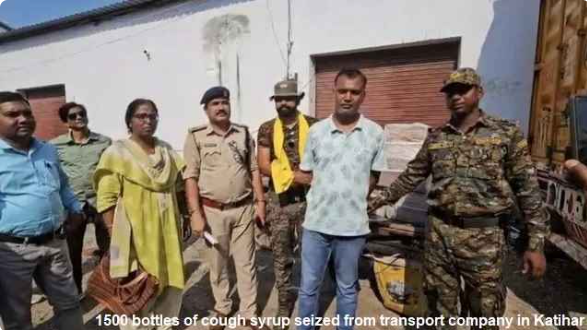
In another major crackdown in Bihar’s Katihar district, police and drug enforcement teams reportedly recovered nearly 1,500 bottles of banned cough syrup during raids targeting suspected narcotics traffickers. A manager associated with the operation was reportedly arrested for questioning. Investigators believe the syndicate may have been using transport and courier services to move pharmaceutical narcotics across districts while avoiding direct retail detection.
Subsequently, another operation in Katihar reportedly uncovered 31 cartons of prohibited cough syrup from courier and transport offices during simultaneous raids. Officials suspect organized interstate trafficking routes are increasingly relying on parcel, courier, and logistics networks to distribute psychotropic medicines and codeine-based syrups in bulk quantities. Police sources indicated that surveillance had been ongoing for several days before the raids were conducted.
In Uttar Pradesh’s Maharajganj district, located close to the Indo-Nepal border, multiple enforcement actions reportedly exposed active cross-border trafficking of narcotic medicines. Police reportedly arrested several accused persons with illegal consignments of capsules, intoxicating syrups, and psychotropic medicines valued in lakhs of rupees. Investigators believe the porous border terrain and heavy movement of goods and people make the region highly vulnerable for illegal transport of pharmaceutical narcotics
One of the largest recent recoveries near the Nepal border reportedly involved narcotic tablets and capsules valued at nearly ₹1 crore. According to reports, enforcement agencies intercepted the consignment based on intelligence inputs regarding movement of psychotropic medicines through border routes. Officials suspect that organized interstate networks are using border districts not only for local distribution but also for possible transnational diversion activities.
Separate action by Purandarpur police in the Maharajganj region reportedly led to the arrest of alleged smugglers carrying narcotic medicines worth around ₹90,000. Authorities recovered capsules and intoxicating pharmaceutical products allegedly intended for illegal sale among addicts and peddlers operating in nearby areas.
In Haryana’s Narnaul region, police reportedly arrested two alleged traffickers with nearly 1,920 Tramadol capsules. Tramadol, an opioid analgesic regulated under NDPS-related controls, has increasingly emerged as a preferred substance in illegal pharmaceutical drug networks because of its addictive and sedative effects. Enforcement agencies have repeatedly flagged misuse of bulk Tramadol consignments diverted from legal channels.
Punjab and adjoining border states also witnessed continuing seizures linked to pharmaceutical drug abuse. In Pathankot, police reportedly recovered narcotic substances and syringes during action connected to criminal activity investigations. Officials expressed concern that injectable abuse and capsule misuse are becoming increasingly common among younger users and repeat offenders involved in street-level drug trade.
In Rajasthan, Bikaner police launched “Operation Neelkanth,” under which raids reportedly resulted in seizure of over 22,000 capsules and tablets suspected to be linked to illegal narcotics distribution networks. Authorities described the operation as part of a broader crackdown against pharmaceutical drug abuse and illegal storage of psychotropic medicines. Investigators are now examining supply sources, distribution chains, and possible involvement of licensed entities.
In another action, Khatushyamji Sadar police in Sikar, Rajasthan, arrested two individuals, including a medical store operator, and seized seven bottles of banned narcotic syrup under the “Operation Anti-Venom 3.0” campaign. The suspects were apprehended on the Mandha-Khatushyamji road while transporting the illegal substances on a motorcycle.
Jammu & Kashmir’s Udhampur district also reported seizure of banned capsules from a youth allegedly involved in illegal possession and transportation of psychotropic substances. Police indicated that increased monitoring has been initiated in response to rising circulation of pharmaceutical intoxicants among youth populations.
In Himachal Pradesh, investigators reportedly arrested an alleged key supplier from Uttarakhand in connection with a pharmaceutical drug smuggling network. Officials suspect interstate supply chains are increasingly being used to transport prescription medicines into regions where monitoring mechanisms are weaker or demand is high.
Additional arrests involving intoxicating medicines and psychotropic substances were also reported from Bihar’s Supaul district and several other locations where police recovered capsules, syrups, and banned formulations allegedly intended for illegal sale.
“Legal Medicines Becoming Street Drugs”
Enforcement agencies say the pattern emerging from these cases clearly indicates that pharmaceutical narcotics are no longer isolated instances of illegal possession but part of organized diversion chains involving suppliers, transport operators, peddlers, stockists, and sometimes licensed distribution channels. Investigators also warn that traffickers are constantly shifting routes and methods, making detection increasingly difficult without coordinated intelligence-sharing between police, drug control departments, and border agencies.
Under Indian law, Codeine formulations beyond prescribed limits, Tramadol, and several psychotropic medicines are regulated under the NDPS Act and Schedule H/H1 provisions of the Drugs Rules, 1945. Their sale without valid prescription is prohibited, and maintenance of detailed purchase and dispensing records is mandatory.
However, repeated seizures across states indicate that implementation remains weak.
Police officials involved in anti-narcotics operations reportedly admit that frontline law-enforcement agencies are fighting “daily battles” against rapidly expanding pharmaceutical drug abuse networks, while inspections of medical stores remain infrequent and prosecution against violators often faces procedural delays.
Investigators say many smugglers prefer pharmaceutical narcotics because:
they are easier to conceal,
legally manufactured products appear less suspicious,
supply chains already exist,
and penalties under drug laws are sometimes enforced inconsistently compared to traditional narcotics trafficking.
Growing Addiction and “Zombie Drug” Concerns
Health experts warn that misuse of Pregabalin, Tapentadol, Tramadol, Codeine syrup, Alprazolam, and related substances is creating a silent addiction crisis, particularly among youth and economically vulnerable populations.
Repeated abuse of these medicines can cause:
respiratory depression,
seizures,
hallucinations,
cognitive impairment,
dependence,
kidney and liver damage,
and fatal overdoses.
Doctors and rehabilitation specialists report increasing cases of patients consuming high doses of prescription capsules and cough syrups in combinations that produce sedative or dissociative effects resembling synthetic street drugs.
Several states have also reported incidents where addicts consuming high quantities of pharmaceutical opioids and psychotropic medicines displayed “zombie-like” behaviour, unconsciousness, violent episodes, or severe withdrawal symptoms.
Weak Enforcement and Regulatory Delays Under Scrutiny
Experts argue that the continuing diversion crisis points toward systemic failures in regulatory enforcement.
Among the major concerns repeatedly highlighted are:
inadequate inspection of pharmacies,
poor digital tracking of Schedule H1 medicines,
weak audit systems for wholesalers,
delayed suspension of licences,
shortage of drug inspectors,
poor coordination between police and drug control departments,
and slow prosecution approval mechanisms.
Officials note that while police frequently seize illegal consignments and arrest peddlers, action against the original diversion points within licensed pharmaceutical supply chains often remains limited or delayed.
Public health advocates are demanding:
real-time digital monitoring of narcotic and psychotropic medicine sales,
mandatory e-prescription verification,
stronger interstate coordination,
stricter scrutiny of wholesalers and transporters,
faster prosecution of erring chemists,
and enhanced border surveillance in vulnerable regions.
Authorities Renew Warning to Chemists
Drug control authorities in several states have reportedly renewed warnings against over-the-counter sale of Schedule H, H1, and NDPS-regulated medicines without valid prescriptions. However, repeated seizures indicate that illegal diversion networks continue to operate extensively despite existing legal safeguards.
Experts caution that unless regulatory enforcement becomes swift, transparent, and technology-driven, legally manufactured medicines intended for genuine patients may continue to feed India’s growing underground narcotics market.