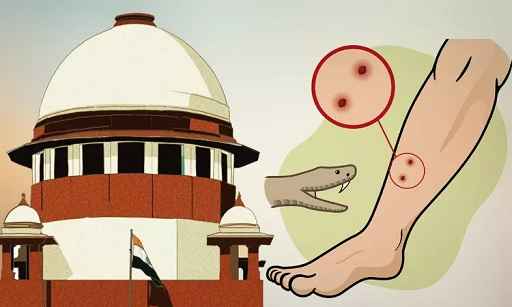
NEW DELHI: The Supreme Court on Friday issued notice to Union of India (UOI) and all the states and Union Territories (UTs) and sought their detailed responses on hearing a petition filed by lawyer, Shailendra Mani Tripathi, seeking a direction to make available poly-venom (anti-venom) and snakebites treatment at PHCs, CHCs (Primary/ Community Health Centres) and district hospitals along with all the govt. hospitals in the country.
The plea urged the apex court to direct authorities to launch a snakebite prevention health mission and public awareness campaign to mitigate the high mortality rate, particularly in rural India.
A two-judge bench of the apex court, led by Justice BR Gavai and Justice KV Viswanathan, issued a notice to the Central, State, UTs governments and asked them to file their replies in four weeks. Advocate Vishal Tiwari appeared for the petitioner, Tripathi.
Tripathi has, in his petition copy, accessed by this newspaper, filed before the apex court, made all the States and Union Territories as parties to his plea.
“To establish snakebites treatment and care units at government district hospitals and government medical colleges,” Tripathi said in his plea.
He also said that Snakebite envenomation (SBE) is an acute, life-threatening, time-limiting, medical emergency affecting 1.8 to 2.7 million people with an estimated 1,38,000 deaths annually across the globe.
“India contributes an average of 58,000 deaths annually. More than 95 per cent deaths occur in rural India. Similar to sub-Saharan Africa, the magnitude of SBE is underestimated in South Asia and South-East Asia. India is one of the world’s most affected countries due to the large population engaged in agricultural activities, use of wattle and daub houses in snakebite-prone rural areas, several slum areas, presence of abundant venomous snakes and lack of community awareness regarding prevention and control of snakebites,” Tripathi said in his petition.
He also highlighted that according to a 2020 study, an average of nearly 58,000 Indian citizens die each year due to snakebites. However, experts say that actual numbers are likely higher because of the number of unreported cases. Doctors and public health experts cite several reasons for the snakebite crisis, including holy reverence for the animal, lack of access to immediate first aid facilities, reliance on “spiritual healers” and a large share of the rural population living close to agricultural fields.
“India faces a significant public health crisis due to the scarcity of antivenom, which is crucial for treating snake bites. Despite this high mortality rate, there is a scarcity of anti-venom (poly-venom). Poly-venom does not reach rural hospitals and healthcare centres where snakebites are most prevalent,” Tripathi said.
Stressing the need of anti-venom medicines is the need of the hour, he said that many rural areas lack adequate stocks of antivenom, leading to delays in treatment for victims who may turn to traditional remedies or local healers instead.
He also pointed out that many healthcare providers in rural areas do not have adequate training or experience in managing snakebites. Doctors and health workers often lack the necessary skills to recognise systemic envenoming and administer antivenom effectively.
This gap in knowledge leads to delayed or inappropriate treatment, which leads to the death of the patient, he said.
“Rural healthcare facilities frequently face high patient loads with limited resources, including staff and medical supplies. This situation overwhelms healthcare providers, making it difficult for doctors to focus on individual cases like snake bites that require immediate attention,” his plea further pointed out.
In hospitals across India, snakebite cases are typically treated in general emergency departments rather than specialised units, so there is immediate attention needed to this.
There is scarcity of educational interventions focusing on safe agricultural practices, recognising venomous snakes, and understanding first aid measures. But the government did not recognise the severity of snake bites.
There are no schemes or projects to tackle this issue rather India is ignoring its deadly snake bites crisis. And thousands of people, especially farmers, are killed every year after being bitten by venomous snakes in India, but little attention is given to treating this “poor man’s disease”, he said.