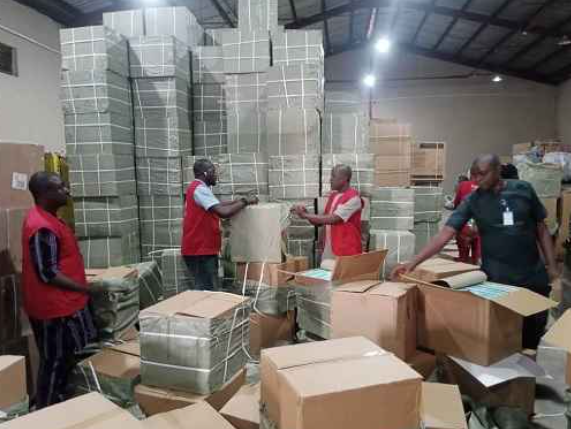
Abuja: The National Agency for Food and Drug Administration and Control (NAFDAC) has intercepted 277 cartons of fake antimalarial drugs with an estimated street value of ₦1.2 billion.
The shipment, concealed in packages labeled as Diclofenac Potassium Enteric Coated 50mg, was discovered in a 40-foot container imported from China.
The counterfeit product, branded MALAMA FORTE and purportedly containing Arthemeter/Lumefantrine 80/480mg, had 18 packs per carton — amounting to about 1,800 doses.
Director of Investigation and Enforcement Directorate, Dr. Martins Iluyomade, disclosed the seizure at a press briefing on Thursday, September 11, 2025. He said the drugs are currently undergoing laboratory analysis to determine their actual content.
Iluyomade explained that the container was traced from Apapa Port, where it had been falsely declared as spare parts. A painstaking intelligence-led operation, coordinated by Deputy Director of the Pharmaceutical Division, Mrs. Florence Uba, led investigators to a warehouse in the Ilasa area of Lagos on August 29, 2025.
“We got to the warehouse while they were offloading. We waited patiently because the first items being offloaded were bicycles, tyres, and other goods. It was only after that we discovered the pharmaceutical products,” Iluyomade said.
He stressed that the operation was part of the Federal Government’s national action plan to curb the circulation of fake and substandard drugs.
“This enforcement action is a follow-up to several other investigations we are carrying out. I want to remind the general public of the nationwide raids we conducted earlier. This is a fight, and we are continuing that fight,” he added.
One suspect, Mr. Paul Chibuzor Uche, was arrested in connection with the consignment, while NAFDAC investigations revealed that the principal importer is based in China.
Iluyomade lamented the devastating effects of fake drugs, linking them to avoidable deaths from treatable illnesses like malaria.
“How many people have died of malaria that could easily be treated? But they die because they are using fake medicines. Imagine the number of doses here — nearly half a million people could have been affected if this made it to the market,” he said.
He assured Nigerians that the agency would pursue the matter to its conclusion and bring all those involved to justice.